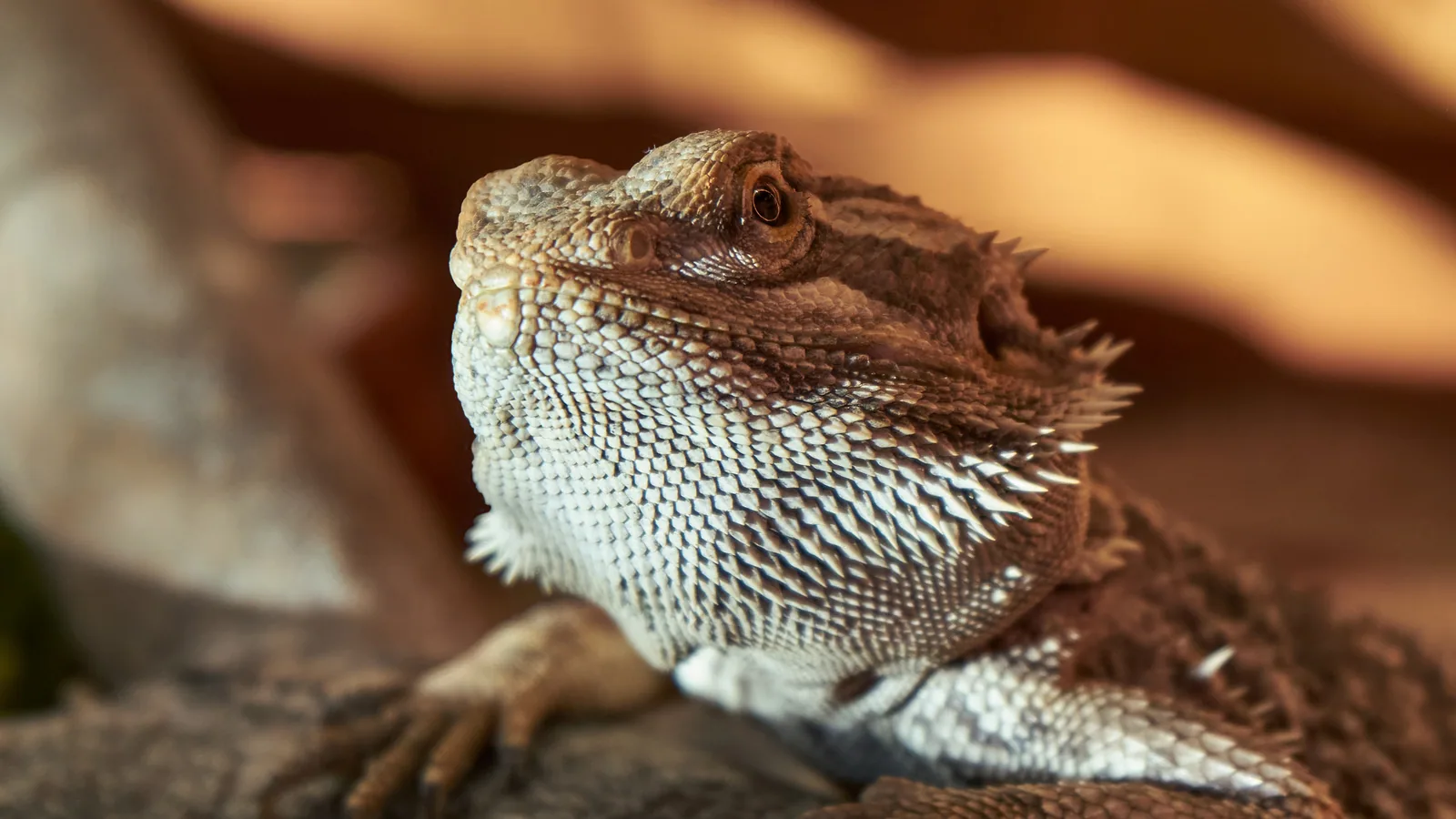
The honest case for
Temperament. This is the reason bearded dragons dominate reptile keeping: Described as highly social with keepers, friendly, animated, curious, docile and gentle; docile and interactive when handled often.
Most dragons tolerate and many appear to accept regular handling, which is unusual among reptiles. That makes them suitable for people who want an animal they can interact with rather than only observe.
They are awake when you are. Diurnal - active during the day A nocturnal pet is a pet you rarely see. A bearded dragon basks, eats, and moves around during your day.
They are quiet and odourless. No noise, no fur, no smell from a properly maintained enclosure. That matters in flats and shared housing.
They are interesting. Lizards have a parietal 'third eye' atop the head with a primitive retina and photoreceptor cells; it detects changes in light and dark and helps regulate hormone production (circadian/thermoregulatory function) They have documented behaviours worth learning to read, covered in the behavior section.
They live a long time. 7 to 15 years, and the record stands at 18 years. That is a positive for anyone wanting a lasting relationship rather than a two-year pet.
The honest case against
The setup is expensive and non-negotiable. Enclosure, UVB fixture and bulb, basking lamp, thermostat, thermometers, hides, and decor, all before the animal arrives: Minimum specialist equipment documented across sources: vivarium (120 cm+ for adults), 60-100 W basking bulb or reptile flood lamp with thermostat, high-output 10-12% UVB tube, ceramic night heater (if needed), two thermometers, hygrometer, UV Index meter, hides, basking furniture and substrate.
The setup cost guide has real prices.
It never becomes low-maintenance. UVB bulbs replaced every 6 to 12 months, feeders bought continuously, daily temperature checks, daily spot-cleaning.
The commitment is genuinely long. Budget for a 10-15+ year commitment (RSPCA UK: 'their lifespan is usually 10 to 15 years or more, so they're quite a commitment') That is longer than many jobs, tenancies, and relationships.
They must live alone. Not social - solitary animals; should be housed individually, and males must be kept separately (territorial) And the reason it matters: House bearded dragons individually: RSPCA SA states they 'can inflict severe damage to each other, resulting in loss of limbs and even death' and that keeping multiple females together 'is not a safe practice and is best to avoid'; RSPCA UK: 'it's best to house bearded dragons separately'. Anyone imagining a pair should read the cohabitation guide first.
Live insects are part of your life. Crickets or roaches in your home, permanently, needing storage and gut loading: Feeder insects should be gut-loaded (fed a high-calcium, nutrient-fortified diet) before feeding: NCSU recommends 24-72 hours prior; PetMD says 6-12 hours before; Merck describes a 3-day gut-load with a 12% calcium (calcium carbonate) diet.
Veterinary care is specialist and costs more. Reptile vets are less common than small-animal clinics, and A reptile-experienced veterinarian should examine a new bearded dragon within 48 hours of purchase (physical exam, weight, oral cavity, skeletal evaluation, fecal parasite test)
Most health problems are your fault. That is uncomfortable and true: Most common bearded dragon health problems are husbandry-linked: metabolic bone disease, impaction, dysecdysis (abnormal shedding), parasites, gout, fatty liver and trauma appear on RSPCA SA's list of common conditions; incorrect diet, lighting and temperature are root causes cited by vet sources.
The health consideration for households with young children
This deserves its own section rather than a footnote, because it is the factor most likely to change a decision.
Reptiles, including bearded dragons, can carry Salmonella bacteria while appearing healthy and clean and showing no signs of illness; carriers shed the bacteria in their feces.
The CDC identifies who is most at risk: CDC: children under 5 years old (highest risk of serious illness), older adults, and people with weakened immune systems are at high risk from reptile-associated Salmonella; households expecting or with infants are advised against acquiring pet reptiles.
And this is not theoretical: A 2024 U.S. Salmonella Cotham outbreak linked to pet bearded dragons involved 27 cases across 14 states; 42% of patients with known outcomes were hospitalized, 65% of confirmed cases were children under 5, and half were infants under 1 year.
One detail from that outbreak matters for how families think about it: Direct contact with the reptile is not required for infection: in the 2024 outbreak, many infected infants and young children had no direct contact with the bearded dragon - household exposure was enough.
The management rules are clear and workable: CDC: wash hands for at least 20 seconds with soap and water right after touching reptiles or anything in the area where they live, and before preparing food or eating. and CDC: keep reptiles out of areas where food or drink is prepared, served, or stored (kitchens, outdoor patios); do not bathe reptiles in kitchen or bathroom sinks - use a tub or bin dedicated to reptile use only; clean reptile equipment outside the house and disinfect any surfaces reptiles contact.
Plus: CDC recommends restricting reptiles from roaming freely in the home, separating reptiles and their supplies from food preparation areas, and washing hands and changing clothes after handling reptiles before holding infants.
Our position: a household with children under 5 should think carefully, and a household that will not enforce hand-washing every single time should choose a different pet.
Who bearded dragons suit
A good fit: someone who enjoys husbandry as part of the hobby, has space for a large enclosure, is comfortable with live insects, can commit for over a decade, and wants a calm animal they can handle.
A poor fit: someone wanting a low-effort starter pet, a household unwilling to run hygiene rules, anyone expecting two dragons to keep each other company, or anyone whose living situation cannot accommodate a large enclosure for 10 to 15 or more years.
Children: a good family animal with adult supervision and enforced hygiene. Not an animal to hand a child as their sole responsibility.
Comparison at a glance
| Factor | Bearded dragon |
|---|---|
| Handling tolerance | High for a reptile |
| Activity pattern | Daytime |
| Noise and odour | Minimal |
| Setup cost | Substantial, mostly enclosure and lighting |
| Ongoing effort | Daily, permanently |
| Lifespan | 7 to 15 years |
| Housing | One dragon per enclosure |
| Live food | Required |
| Hygiene requirements | Real, and enforceable |
Source note: temperament and husbandry from RSPCA, VCA, and veterinary hospital guidance; Salmonella data from the CDC, cited below.
Before you decide
Read the setup cost guide for what day one actually costs, the care routine guide for what daily life looks like, and the habitat section for the equipment.
If all of that reads as interesting rather than tedious, you will probably enjoy keeping one. If it reads as a chore list, that is useful information too, and better discovered now than by an animal that ends up rehomed.