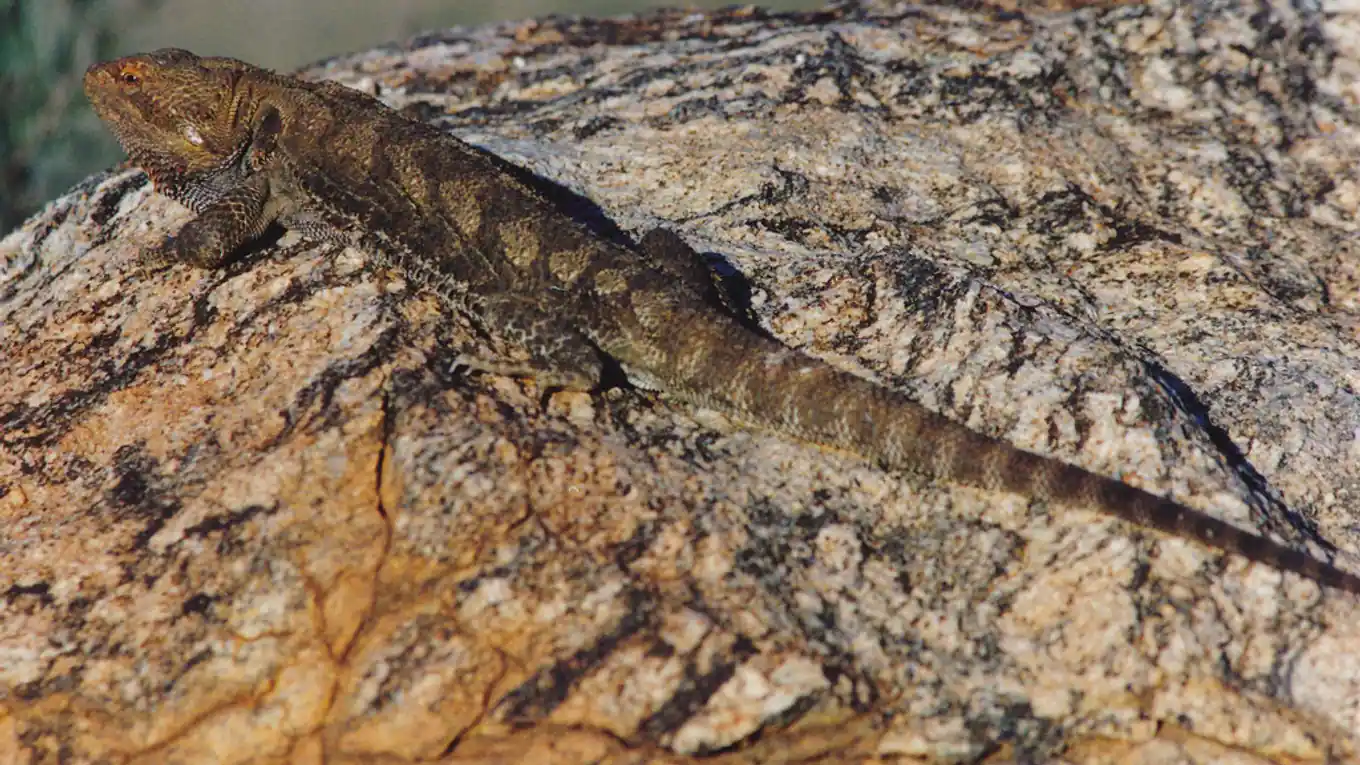
What healthy looks like
The veterinary description is specific enough to use as a checklist: A healthy bearded dragon is alert, active, and aware, with clear bright eyes, a thick round tail base, hips that do not protrude, a clean dry vent, bright pink mouth tissue, and clear saliva.
Break that into what you actually observe in a shop or at a breeder.
Alert and responsive. The dragon tracks movement, reacts to your approach, and holds its head up. A dragon flat and unreactive in a lit enclosure during the day is a concern, since this is a daytime animal: Diurnal - active during the day
Clear, bright, open eyes. Both of them, fully open, without discharge or swelling.
A full, rounded tail base. Fat is stored in the tail, so this is the body condition indicator that matters most.
Firm body, no visible hip bones or ribs. Weight is carried evenly.
Clean vent. No staining, no adherent material.
All toes and a complete tail. Missing toe tips often mean past shedding problems: Retained shed shrinks as it dries and can constrict circulation, especially on toes and tail tips; poor shedding on the feet can cut off blood supply and lead to loss of toes or tissue death requiring amputation.
The warning signs
The documented list: Signs of an unhealthy dragon include a skinny appearance or loose skin, sunken eyes, lethargy or inactivity, a sunken bony tail, wet or soiled vent, cloudy mucus or cottage-cheese-like material in the mouth, and gum redness or pinpoint hemorrhages.
Those are the ones to walk away from. A few deserve elaboration.
Sunken eyes point toward dehydration: Sunken eyes, sticky mucus in the mouth, and retained non-shedding skin can all be signs of dehydration; sunken eyes also suggest weight loss.
Loose skin or a thin tail signals weight loss: Observable weight-loss signs in lizards include tail thinning (fat is stored in the tail), prominent ribs, and defined skull bones.
Any respiratory sign matters immediately: Signs include sneezing, discharge from the eyes or nose, bubbles from the mouth or nose, rapid or shallow breathing, open-mouth breathing, difficulty breathing, decreased appetite, and lethargy.
Mouth abnormalities deserve a careful look: Signs include pinpoint hemorrhages on the gums, red/inflamed or bleeding gums, gum swelling, excessive thick mucus, cottage-cheese-like material in the mouth, loss of appetite, inability to close the mouth, and jaw swelling in advanced cases.
With one reassuring exception: Some bearded dragons naturally have yellow pigmentation inside the mouth - this alone is normal and not a sign of disease; healthy mouth tissue is bright pink with clear saliva.
A blackened tail tip is a specific and serious finding: In tail rot, the end of the tail turns black, appears shriveled, and feels mushy, with infection through the tail's circumference; it requires aggressive veterinary intervention and may need surgical amputation.
Weakness, tremors, or jaw swelling point to the most common preventable disease: Signs include weakness or difficulty walking, swollen or softened 'rubber' jaw, swollen or deformed limbs, muscle tremors or twitching, lethargy, loss of appetite, fractures, and seizures in advanced cases; RSPCA also lists permanently deformed limbs or spine.
Why subtle signs matter more here than in a mammal
The single most important principle when assessing a reptile: Reptiles typically do not show signs of illness until disease has significantly progressed, so subtle changes matter and owners should not wait to see if the lizard recovers on its own.
The health section covers each condition in detail. A dog with a mild illness looks mildly ill. A bearded dragon showing any visible sign has usually been unwell for some time. So a dragon that is merely a bit quiet, or eating slightly less than its enclosure mates, warrants more concern than the equivalent in a mammal, not less.
Inspect the enclosure, not only the animal
This is where experienced buyers gather the most information, because conditions predict problems that are not yet visible.
Are dragons housed together? House bearded dragons individually: RSPCA SA states they 'can inflict severe damage to each other, resulting in loss of limbs and even death' and that keeping multiple females together 'is not a safe practice and is best to avoid'; RSPCA UK: 'it's best to house bearded dragons separately'. Cohabited animals may carry bite damage or be nutritionally behind from losing basking access: Males head-bob with an inflated, blackened beard to signal dominance; smaller/subordinate dragons respond with arm waving as a submission signal.
Is there a UVB source, and how old is it? Bearded dragons rely on UVB light to synthesize vitamin D3 in the skin; D3 is essential for calcium metabolism, and without adequate UVB they can develop metabolic bone disease (nutritional secondary hyperparathyroidism), weak bones and fractures. Ask when the bulb was last changed, since Replace UVB bulbs on schedule even if still emitting visible light: every 6 months (NCSU, VCA, PetMD); WSU: every 6-8 months for juveniles, yearly for adults; Merck: fluorescent every 9-12 months; RSPCA SA: effective UVB lifespan typically 6-12 months - follow manufacturer guidance.
Is anything between the bulb and the animal? No glass or plastic (or fine mesh) may sit between the UVB source and the dragon - these filter out UVB; sunlight through a window is not sufficient.
Is there a thermal gradient? A hot-to-cool temperature gradient is mandatory so the dragon can thermoregulate within its preferred optimal temperature zone (POTZ) A single warm box with no cool end is a husbandry failure.
Is the substrate on the banned list? Avoid substrates linked to gut impaction or toxicity: sand including calcium-based 'calci-sand' (VCA, NCSU, RSPCA SA), gravel/pea gravel, wood chips/shavings, corn cob, crushed walnut shells, cat litter, and cedar (toxic) or pine shavings.
Is the enclosure clean? Spot-clean waste daily (or immediately when seen); remove uneaten insects from the enclosure.
Is water available? Provide a shallow dish of fresh water the dragon can step into, changed/cleaned daily; fresh clean water should always be available.
A seller keeping animals well is a seller whose animals are more likely to be well.
Questions worth asking
How old is this dragon, and can you sex it? Bear in mind: Sexing bearded dragons under three months of age is very challenging; sex differences become clear as animals mature.
What has it been eating, and how often? Compare the answer against age-appropriate guidance: Juveniles 1-4 months old should be fed twice daily (crickets, veggies, occasional super/mealworm)
Is it supplemented, and how? Dust food with plain calcium powder about 4-5 times weekly for juveniles (WSU); VCA recommends calcium powder daily for growing dragons.
When did it last shed, and did it shed cleanly?
When did it last defecate, and did it look normal? Decreased stool production typically indicates reduced food intake or constipation and warrants veterinary evaluation; brumating dragons normally stop defecating while eating little.
Has it seen a vet? Any health history?
Which morph, and what were the parents? Relevant if leatherback genetics are in the line: Breeding leatherback x leatherback yields approximately 25% normal-scaled, 50% leatherback, 25% silkback offspring (classic incomplete-dominance ratio); no hidden 'het' carriers - the trait is always visible
A seller who answers these easily is a good sign in itself.
Watch it move and, if possible, eat
Ask to see the dragon walk. It should lift its body off the ground and move with coordination. A dragon dragging its belly or with weak back legs may have skeletal problems: Signs include weakness or difficulty walking, swollen or softened 'rubber' jaw, swollen or deformed limbs, muscle tremors or twitching, lethargy, loss of appetite, fractures, and seizures in advanced cases; RSPCA also lists permanently deformed limbs or spine.
If the seller is willing, watch it take an insect. A healthy dragon shows a clear feeding response. Loss of appetite is one of the earliest illness indicators: Leaving food after a meal can be one of the first signs of illness in a lizard, and not eating at all - even once - is a sign that cannot be ignored.
After you buy
The first appointment is not optional: A reptile-experienced veterinarian should examine a new bearded dragon within 48 hours of purchase (physical exam, weight, oral cavity, skeletal evaluation, fecal parasite test)
That visit catches what a shop assessment cannot, particularly parasites, which are common even in captive-bred animals: Many bearded dragons, even captive-bred ones, carry pinworms or other gastrointestinal parasites; pinworms are roundworms detected by microscopic fecal examination.
And often invisible: Parasitized dragons often show no visible signs; advanced cases can show abnormal droppings, mild loose stool to foul-smelling feces, profuse diarrhea, constipation, and weight loss - a vet fecal test is needed to diagnose.
Quarantine any new dragon away from other reptiles: The infection spreads between reptiles; quarantine new reptiles before introduction, isolate affected animals, disinfect enclosures (e.g., 10% bleach with at least 2-minute contact), wash hands and sanitize tools between handling different reptiles.
Quick reference: the shop checklist
| Check | Pass | Walk away |
|---|---|---|
| Alertness | Tracks movement, head up | Flat, unresponsive in daylight |
| Eyes | Clear, bright, both open | Sunken, swollen, closed, discharge |
| Tail base | Full and rounded | Thin, bony |
| Body | Firm, even | Loose skin, visible hips |
| Mouth | Even pink tissue | Redness, swelling, mucus, sores |
| Limbs | Coordinated, lifts body | Weakness, tremors, dragging |
| Vent | Clean | Staining, adherent material |
| Enclosure | UVB current, gradient, clean | Cohabited, no UVB, banned substrate |
Source note: healthy and unhealthy indicators from VCA, PetMD, and Washington State University's veterinary teaching hospital, cited below.
The buying guide covers where to look, and the warning signs guide covers what to do if problems appear later.