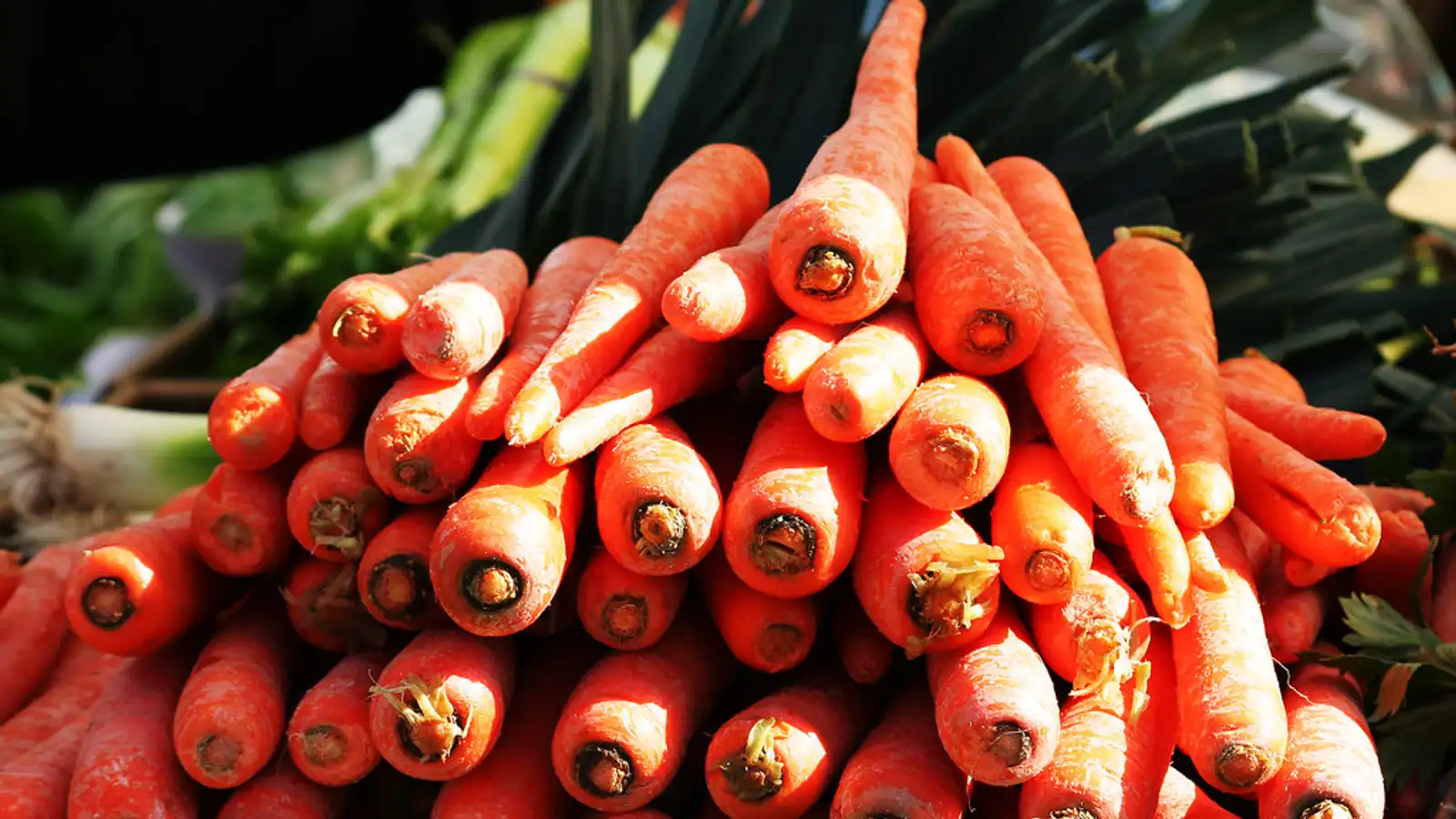
Carrot is on the recommended list
Most foods in this series are permitted with caveats. Carrot is different: it appears in the vegetables that veterinary sources actually recommend feeding.
Other (non-leafy) vegetables recommended: squash, zucchini, sweet potato, carrot, bean sprouts, broccoli (NCSU); squash, peas, beans (RSPCA); squash, zucchini, sweet potato (WSU)
That is NC State's veterinary hospital and the RSPCA naming carrot among suitable vegetables, not a grudging concession. VCA lists it too, among the secondary vegetables: VCA Animal Hospitals lists cucumber among the secondary vegetables for bearded dragons, alongside asparagus, cactus, carrots, cooked sweet potato, corn, mushrooms, okra, parsnips, peas, sprouts, and squash, separate from its main list of greens.
So carrot has a legitimate place. The question worth answering is where.
Where carrot sits in the salad
A bearded dragon's plant portion is not one undifferentiated pile. It has a documented structure: 80-90% of the plant material fed should be leafy green vegetables; fruit plus yellow/red/orange vegetables should be only 10-20% of the plant portion.
Read that carefully, because it settles the carrot question exactly. Leafy greens are the base. Carrot belongs in the smaller slice alongside other bright vegetables and fruit, which means a supporting role rather than a headline one.
The base itself is specific: Calcium-rich staple greens include collard greens, mustard greens, turnip greens, and dandelion greens.
A practical adult salad: a bed of collard, mustard, turnip, or dandelion greens, with a spoonful of grated carrot or squash turned through it. Not a bowl of carrot with a leaf on top.
Preparation, which matters more than you would guess
Carrot is the hardest vegetable most owners will offer, and hardness is the whole issue.
Grate it raw. A fine grate breaks the fibre structure down enough for a dragon to manage. Raw is correct; cooked carrot goes mushy and loses texture, though cooked and cooled is acceptable if that is what your dragon accepts.
Never serve chunks or rounds. A carrot coin is hard, round, and exactly the shape that causes problems. The rule veterinary sources apply to prey items is the right guide: Never feed an insect whose length is greater/wider than the width of the dragon's head; RSPCA: live food greater than the width of the dragon's head should not be offered.
Peel or scrub. Either works. The skin holds soil residue, so scrub it well if you leave it on.
Serve in a dish. Offer food in a separate dish or feeding container rather than on the substrate to reduce accidental substrate ingestion.
Skip carrot tops for now. The leafy green tops are eaten by some keepers' dragons, but none of the veterinary sources we cite names carrot greens as a recommended food, so we do not recommend them. Stick to the greens that are named.
How often
Carrot works well as a rotating supporting vegetable a couple of times a week, mixed into an otherwise leafy salad. It is not a daily item, and not because it is dangerous. It is because the bright-vegetable slice of the plant portion is small, and squash, zucchini, sweet potato, and bell pepper are all competing for the same space.
Rotation matters more than any single choice. A dragon eating four different greens and two different supporting vegetables across a week has a sturdier diet than one eating the same two items daily, however well chosen.
The vitamin A question, handled carefully
Carrot is famous for beta-carotene, and this leads to a reasonable question about carrot-heavy diets and vitamin A problems in reptiles.
Here is what our sources actually support. Feeder insects are noted as deficient in this nutrient: Feeder insects are low in calcium and vitamin A; feeder invertebrates are best fed a formulated diet fortified with calcium and vitamin A ('gut loading')
So the documented concern in bearded dragon nutrition runs the other way: insects supply too little vitamin A, which is part of why gut loading uses fortified diets. None of the veterinary sources we cite warns about carrot causing vitamin A excess in bearded dragons, and we will not manufacture a warning that the evidence does not contain.
What we will say is that supplements are a separate matter from food. Over-supplementation is a real phenomenon in reptile keeping, and the calcium and supplements guide covers dosing schedules properly. Vegetables in a varied salad are not where that risk lives.
The calcium context every vegetable sits inside
The diet is judged on one relationship above all: The calcium:phosphorus ratio of the diet should be at least 1:1, with 2:1 preferred (Merck); WSU and Illinois WEL state the ideal Ca:P ratio is 2:1.
Carrot is not a calcium source. Its job is variety, fibre, and moisture, while the leafy base carries the minerals. That division of labour is the whole reason greens hold the majority of the plant portion.
The insect half of the diet makes the same point from the other direction: Feeder insects naturally contain extremely low calcium (about 0.03-0.3%) with 0.8-0.9% phosphorus; a 3-day 12% calcium gut-load raises insect calcium to roughly 0.8-0.9%, giving a Ca:P ratio of approximately 1.2:1.
With insects running that far from target, the salad has to do real work, and a salad dominated by carrot is not doing it. Sustained, that shortfall produces metabolic bone disease, the most common preventable condition reptile vets see in this species.
One more sourced nuance is worth knowing when you pick greens, because not every green is equal: Swiss chard, spinach, and beet greens should be fed sparingly because they contain oxalates, which can bind calcium and other trace minerals and prevent their absorption.
Age differences
Adults eat the largest plant portion, so carrot has the most room in an adult diet. Juveniles run the opposite way: Live insects should make up about 70% of a juvenile bearded dragon's diet, with vegetables about 20-30% and only small amounts of fruit.
For a growing dragon, the small plant portion should be almost entirely calcium-carrying greens. A little grated carrot is fine as variety; it should not be displacing collard greens at that age. The feeding schedule guide sets out the ratios by age band, and the vegetable guide covers the full recommended list.
What to watch
Carrot sometimes tints droppings orange, which is harmless and purely cosmetic. The droppings guide covers what a healthy baseline looks like so you can tell colour from a real change.
Uneaten carrot dries out quickly and should come out the same day, alongside any live insects: Uneaten live insects left in the enclosure can seriously harm the dragon.