The verdict and the list it comes from
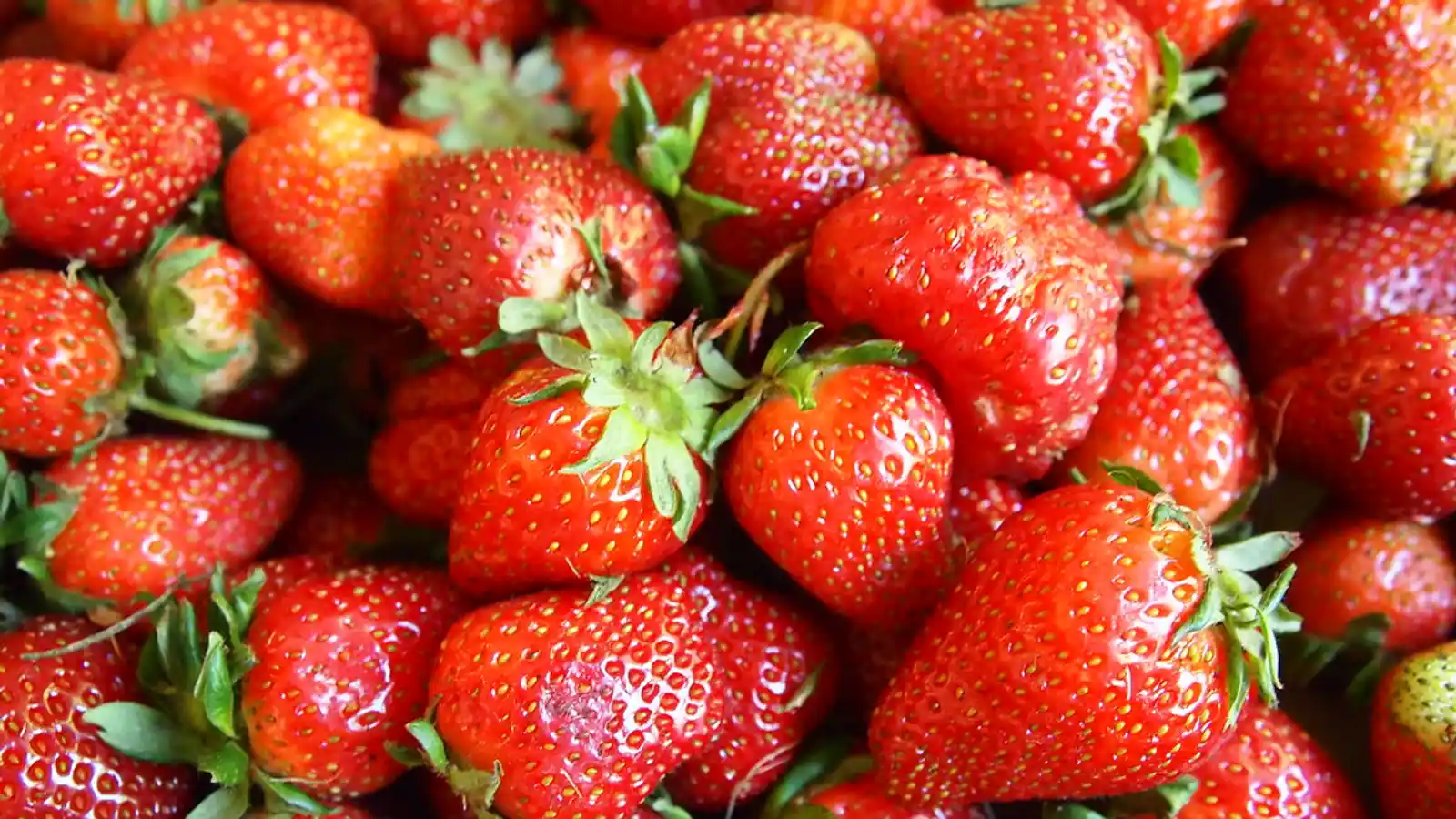
Strawberries are a safe occasional treat. They sit on the veterinary list of acceptable fruits: Safe occasional fruits include papaya, melon, watermelon, banana, figs, apples, mango, dates, peaches, apricots (NCSU), strawberries and blueberries (PetMD), and apple, apricot, banana, dates, figs, grapes, guava, kiwi, mango, melon, peach, pear, raspberry, star fruit, strawberry, tomato (VCA)
What that list does not do is set a portion, so owners guess. Owners guess badly with berries for one structural reason, covered next.
The portion trap with berries
A grape is obviously one unit. A strawberry is obviously one unit. But a strawberry is several times the volume of a grape, and a bowl of sliced berries reads as a modest handful while carrying a great deal more sugar than the same visual quantity of any staple green.
The governing limit is a share of the whole diet, not a count: Fruit should be limited to at most about 5% of the total diet (NCSU/WSU/PetMD) because it is high in sugar; VCA allows fruit as 10-20% of the plant portion only, 'as a treat only'.
And fruit competes for space with the part of the salad doing real work: 80-90% of the plant material fed should be leafy green vegetables; fruit plus yellow/red/orange vegetables should be only 10-20% of the plant portion.
A workable rule: one medium strawberry, sliced, once or twice a week for an adult, mixed into a salad that is otherwise greens. That keeps you comfortably inside both limits. If your dragon eats fruit on other days that week, skip it.
Fitting strawberries into a weekly plan
Portion advice works better as a schedule than as a rule, so here is one that respects both limits.
An adult dragon eats a salad most days, built around the staple greens: Calcium-rich staple greens include collard greens, mustard greens, turnip greens, and dandelion greens. On five or six of those days the salad is greens plus a supporting vegetable, and nothing else. On one day, a sliced strawberry goes in among the greens.
That single fruit day covers the whole week's fruit allowance. If you also want to offer melon or apple, they share that same day rather than claiming another one. The mistake that quietly breaks the cap is treating each fruit as having its own schedule, which turns a 5 percent allowance into a fruit salad.
Juveniles work differently, because their intake is weighted toward growth: Live insects should make up about 70% of a juvenile bearded dragon's diet, with vegetables about 20-30% and only small amounts of fruit. Fruit is not part of that equation in any meaningful way, and the feeding schedule guide sets out what each age band actually needs.
Preparation, top to bottom
The seeds are fine. Strawberry seeds sit on the outside and are tiny. None of our cited veterinary sources flags them as a hazard, and they pass without issue.
The green top comes off. The calyx and stem are fibrous and offer nothing. Remove them.
Wash properly. Strawberries are eaten whole with the skin, and they hold surface residue well.
Slice to size. The same rule that governs feeder insects applies to fruit chunks: Never feed an insect whose length is greater/wider than the width of the dragon's head; RSPCA: live food greater than the width of the dragon's head should not be offered.
Serve in a dish. Offer food in a separate dish or feeding container rather than on the substrate to reduce accidental substrate ingestion.
Anything uneaten comes out the same day. Fruit ferments, attracts insects, and raises local humidity in an enclosure that should sit at 30 to 40 percent.
Frozen, dried, and processed strawberries
Fresh is the only form our sources support, and the alternatives fail for specific reasons rather than vague ones.
| Form | Assessment |
|---|---|
| Fresh, sliced | The form veterinary lists refer to |
| Frozen, thawed | Texture collapses; serve only if fully thawed and drained |
| Freeze-dried | Sugar concentrated by water removal, works against the fruit cap |
| Jam, syrup, yogurt-coated | Added sugar and dairy; never appropriate |
| Strawberry-flavored anything | Not food for a reptile |
Source note: form assessments follow the fruit-share and sugar guidance from NC State, WSU, and PetMD cited below.
Why sugar matters more in a lizard than it sounds
This is the part worth understanding properly, because "fruit is high in sugar" is repeated everywhere without a mechanism attached.
A bearded dragon is a desert omnivore whose wild plant intake is leaves and the occasional fruit, not orchard produce. In the wild they feed on vegetation including fruit and leaves, invertebrates (including ants and beetles), and small vertebrates such as lizards.
Captive fruit is bred for sweetness, and it arrives on a schedule the animal never evolved for. Two consequences follow. The first is metabolic: sustained excess energy in a low-activity captive lizard produces obesity, and obesity compounds every other health problem the animal can develop. The second is mineral, and it is the one keepers underestimate.
Diet quality here is judged as a ratio. The calcium:phosphorus ratio of the diet should be at least 1:1, with 2:1 preferred (Merck); WSU and Illinois WEL state the ideal Ca:P ratio is 2:1. Staple greens exist to push that ratio upward: Calcium-rich staple greens include collard greens, mustard greens, turnip greens, and dandelion greens. Sweet fruit contributes very little calcium, so it functions as dilution. Combine that with the insect side, where Feeder insects naturally contain extremely low calcium (about 0.03-0.3%) with 0.8-0.9% phosphorus; a 3-day 12% calcium gut-load raises insect calcium to roughly 0.8-0.9%, giving a Ca:P ratio of approximately 1.2:1., and a diet that looks varied and generous can quietly run a calcium deficit. The endpoint of that deficit is metabolic bone disease, the most common preventable illness in the species.
So the strawberry is not dangerous. The habit around it is what needs managing.
What to watch after a fruit day
Loose droppings are the common short-term result of too much fruit, and the droppings guide shows the normal baseline to compare against. Over longer periods, watch weight and watch appetite for greens. A dragon refusing salad while eagerly taking fruit has learned a habit worth breaking, and the feeding schedule guide sets out the structure that prevents it.