Mistake 1: treating the UVB bulb as permanent
This is the most consequential error in the hobby, and it is invisible by design.
UVB drives the vitamin D3 a dragon needs to use calcium at all: Bearded dragons rely on UVB light to synthesize vitamin D3 in the skin; D3 is essential for calcium metabolism, and without adequate UVB they can develop metabolic bone disease (nutritional secondary hyperparathyroidism), weak bones and fractures.
The output fades on a schedule the eye cannot detect: Replace UVB bulbs on schedule even if still emitting visible light: every 6 months (NCSU, VCA, PetMD); WSU: every 6-8 months for juveniles, yearly for adults; Merck: fluorescent every 9-12 months; RSPCA SA: effective UVB lifespan typically 6-12 months - follow manufacturer guidance.
A bulb eighteen months old lights the tank perfectly and may be doing nothing useful. The dragon underneath develops a calcium deficit with no visible cause, and the endpoint is documented: Metabolic bone disease (MBD) is one of the most common and preventable diseases of pet bearded dragons.
The fix: write the install date on the fixture in marker. Replace on schedule regardless of appearance. The UVB guide covers bulb types and placement.
Mistake 2: blocking the UVB you paid for
A related error wastes a perfectly good bulb: No glass or plastic (or fine mesh) may sit between the UVB source and the dragon - these filter out UVB; sunlight through a window is not sufficient.
A UVB tube mounted above a mesh lid loses output; one shining through glass delivers essentially nothing. Owners with correct equipment still end up with deficient dragons this way.
Distance matters too: VCA: UVB bulb within 6-18 inches of the pet; WSU: position bulb 30-45 cm above the basking area; Merck: fluorescent UVB strips must be within about 30 cm (12 in)
Mistake 3: guessing temperatures
A bearded dragon cannot generate body heat, so the enclosure is its metabolism. Guesswork is not husbandry.
The requirement: A hot-to-cool temperature gradient is mandatory so the dragon can thermoregulate within its preferred optimal temperature zone (POTZ)
And the equipment: Use two thermometers, one at the cool end and one at the warm end near the heat source.
Stick-on dial thermometers are widely sold and widely inaccurate. A digital probe or infrared thermometer at each end is the working setup. Targets are 95 to 110 F (35 to 43 C) for basking and 75 to 80 F (24 to 27 C) at the cool end, with nights no colder than 65 to 70 F (18 to 21 C).
A dragon running cool digests slowly, eats less, and fights infection worse. It rarely looks dramatic, which is exactly the problem.
Mistake 4: the tank that never got upgraded
Hatchling tanks are cheap and adult dragons are not small: Adults roughly 33-61 cm (13-24 in) total length including tail; VCA gives 45-56 cm (18-22 in); Australian Museum gives up to 55 cm; about half the length is tail.
Adult housing requirements are specific: 40 gallons at minimum, with 60 to 100 gallons widely recommended and at least 120 cm long by 60 cm wide by 60 cm high
The underlying rule: Enclosure length should be at least 3x the lizard's total body length; VCA adds minimum width of 16 inches.
An undersized enclosure cannot hold a proper thermal gradient, which converts a space problem into a heat problem. The tank size guide covers sizing by age.
Mistake 5: feeding insects straight from the tub
Feeder insects are not complete food. The numbers are stark: Feeder insects naturally contain extremely low calcium (about 0.03-0.3%) with 0.8-0.9% phosphorus; a 3-day 12% calcium gut-load raises insect calcium to roughly 0.8-0.9%, giving a Ca:P ratio of approximately 1.2:1.
Two steps fix that. First: Feeder insects should be gut-loaded (fed a high-calcium, nutrient-fortified diet) before feeding: NCSU recommends 24-72 hours prior; PetMD says 6-12 hours before; Merck describes a 3-day gut-load with a 12% calcium (calcium carbonate) diet.
Then: Lightly coating insects with calcium powder (shaking in a bag) can supplement calcium but 'is not a substitute for appropriate gut loading'.
With a timing detail that decides if it worked: Gut-loaded feeder insects need to be eaten by the lizard within an hour of the insects being fed (gut-loaded)
The target: The calcium:phosphorus ratio of the diet should be at least 1:1, with 2:1 preferred (Merck); WSU and Illinois WEL state the ideal Ca:P ratio is 2:1. Miss this routinely and the outcome is predictable: Most feeder insects are low in calcium; without supplementation (gut loading, dusting) and adequate UVB, dragons are at risk for metabolic bone disease.
Mistake 6: feeding an adult like a juvenile
The diet inverts as a dragon grows, and many owners never make the switch: Diet shifts with age: hatchlings/young juveniles eat roughly 70% insects / 30% vegetation, flipping in adulthood to mostly vegetation (RSPCA Australia: adults ~90% vegetation / 10% animal matter; PetMD: adults 70-80% plants)
The result is an obese adult on an insect-heavy diet. This is common enough to have been measured: A Tufts-affiliated survey of 405 bearded dragon owners found approximately half were feeding a diet with less than 50% plant material and more than 50% insects, and researchers noted a need for clear evidence-based nutritional guidelines on food type, quantity, and frequency.
The feeding schedule guide covers the transition.
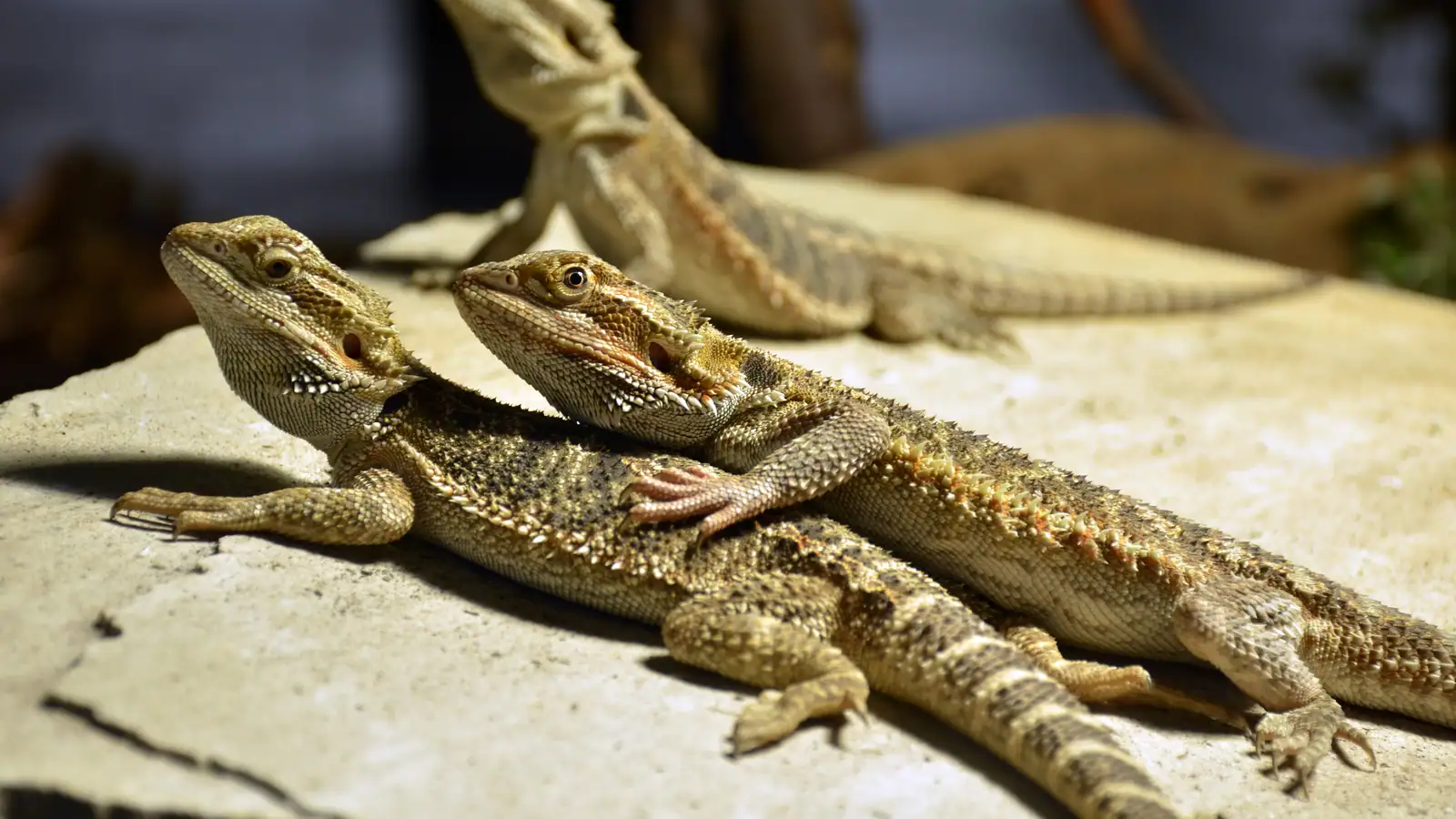
Mistake 7: housing two dragons together
The reasoning sounds kind and the outcome is not. House bearded dragons individually: RSPCA SA states they 'can inflict severe damage to each other, resulting in loss of limbs and even death' and that keeping multiple females together 'is not a safe practice and is best to avoid'; RSPCA UK: 'it's best to house bearded dragons separately'.
Specifically: Never keep more than one adult male per enclosure - males are territorial and will fight; adult females kept together also require monitoring for aggression.
Dominance is expressed physically in this species: Males head-bob with an inflated, blackened beard to signal dominance; smaller/subordinate dragons respond with arm waving as a submission signal.
The subordinate animal loses access to the basking spot, which means it loses access to digestion and immune function. The cohabitation guide covers it fully.
Mistake 8: the wrong substrate for the wrong dragon
Sources genuinely differ here, and we show the disagreement rather than picking a side: Sources differ on loose substrate: US veterinary sources (VCA, NCSU) advise against all sand due to impaction risk, while RSPCA UK permits reptile-safe sand or sand/soil mix with a digging box, and RSPCA SA lists sand as an option but excludes calci-sand; all sources agree calci-sand, gravel, corn cob and walnut shell are unsafe.
What every source agrees on is the banned list: Avoid substrates linked to gut impaction or toxicity: sand including calcium-based 'calci-sand' (VCA, NCSU, RSPCA SA), gravel/pea gravel, wood chips/shavings, corn cob, crushed walnut shells, cat litter, and cedar (toxic) or pine shavings.
And a simple mitigation that works regardless of position: Offer food in a separate dish or feeding container rather than on the substrate to reduce accidental substrate ingestion.
Mistake 9: skipping the vet until something is obviously wrong
By the time a reptile looks ill, it has usually been ill for a while: Reptiles typically do not show signs of illness until disease has significantly progressed, so subtle changes matter and owners should not wait to see if the lizard recovers on its own.
The standard schedule exists for that reason: Healthy bearded dragons should have a veterinary wellness examination once every year, ideally bringing a fresh fecal sample for parasite screening; regular annual checkups plus proper environment help catch and prevent illness early.
And for new arrivals: A reptile-experienced veterinarian should examine a new bearded dragon within 48 hours of purchase (physical exam, weight, oral cavity, skeletal evaluation, fecal parasite test)
Mistake 10: handling badly
A grab from above, a lift by the tail, or a squeeze produces a dragon that dreads hands. The correct method: Support the whole body from underneath including fore and hind limbs; do not squeeze; RSPCA UK suggests about 10-15 minutes at a time as a safe handling period; over-handling is stressful.
And a physical fact that makes tail grabs worse than people assume: Bearded dragons (Pogona) lack tail autotomy: in a peer-reviewed review of agamid autotomy, all examined specimens of P. barbata and P. vitticeps had intact tails and no literature documents pseudoautotomy in these species; a lost or amputated tail is permanent.
The handling guide covers technique and taming.
The pattern behind all ten
| Mistake | What it actually causes |
|---|---|
| Expired or blocked UVB | Metabolic bone disease |
| Unmeasured temperatures | Poor digestion, weakened immunity |
| Undersized tank | No usable thermal gradient |
| Undusted feeders | Calcium deficit |
| Adult fed like a juvenile | Obesity |
| Two dragons together | Injury, stress, blocked basking |
| Banned substrate | Impaction risk |
| No routine vet care | Late detection |
Source note: husbandry requirements and disease links from RSPCA care sheets, Washington State and NC State veterinary hospitals, VCA, and PetMD, cited below.
Every item traces to the same root: this animal's health is mostly decided by its environment. Get the habitat right and the care routine consistent, and most of the health section becomes reading you never need.