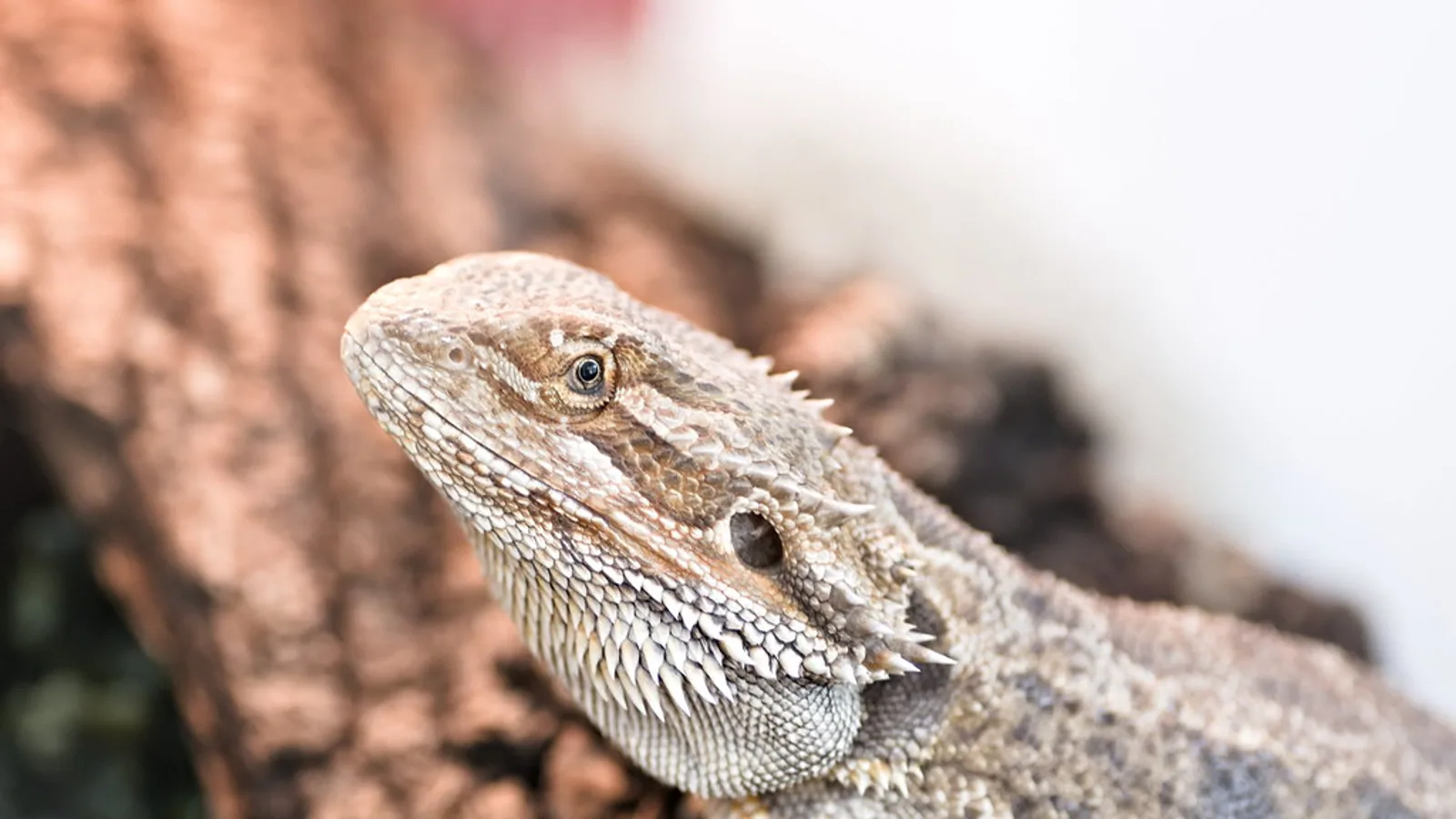
The setup a hatchling needs before it arrives
A baby dragon does not need a baby tank for long. Juveniles can start in a minimum 20-gallon enclosure and need upgrading as they grow. The sizing rule that governs the upgrade is simple: Enclosure length should be at least 3x the lizard's total body length; VCA adds minimum width of 16 inches. Since the adult will reach 45 to 60 cm (about 18 to 24 inches), most owners save money by skipping the starter tank and dividing a full-size enclosure with a temporary partition instead. Our tank size guide walks through both routes.
Floor covering matters more for a baby than for any other age, because a hatchling hunts by lunging at anything that moves and swallows what it catches, substrate included. Avoid small-particle loose substrates because bearded dragons will eat bedding made of small particles; safer options include newspaper, paper towels, or reptile carpet, and insects should be fed in a dish to avoid substrate ingestion. Avoid substrates linked to gut impaction or toxicity: sand including calcium-based 'calci-sand' (VCA, NCSU, RSPCA SA), gravel/pea gravel, wood chips/shavings, corn cob, crushed walnut shells, cat litter, and cedar (toxic) or pine shavings. Paper towel is the boring, correct answer for the first months: cheap, replaced daily, and impossible to swallow.
Furnish both ends. Provide hiding places at BOTH the warm and cool ends of the enclosure; hides can be commercial caves, clay pots or cardboard boxes. A baby that can hide sleeps better and stresses less, and stress is the quiet reason many hatchlings stop eating in their first week. Put the feeding dish in from day one as well: Offer food in a separate dish or feeding container rather than on the substrate to reduce accidental substrate ingestion.
Heat and light for a growing dragon
Temperatures do not scale down with the animal. The gradient a baby needs is the same one an adult needs, and the table shows the published targets:
| Zone | Target |
|---|---|
| Basking surface | 95 to 110 F (35 to 43 C) |
| Cool end | 75 to 80 F (24 to 27 C) |
| Night minimum | no colder than 65 to 70 F (18 to 21 C) |
| Humidity | 30 to 40 percent |
Source note: ranges pool VCA, WSU, NC State, PetMD and both RSPCA care sheets; each organization's exact figure is in our temperature guide.
Use two thermometers, one at the cool end and one at the warm end near the heat source. A single dial thermometer stuck to the glass tells you nothing about the surface a small lizard is lying on. Basking lamp must not be positioned too close to the lizard (RSPCA UK: back no closer than 25-30 cm from the lamp); basking area should be as large as the dragon so the whole body heats evenly; guard lamps to prevent burns.
UVB is where baby care is most often done badly, and the consequences land hardest on the young. Bearded dragons rely on UVB light to synthesize vitamin D3 in the skin; D3 is essential for calcium metabolism, and without adequate UVB they can develop metabolic bone disease (nutritional secondary hyperparathyroidism), weak bones and fractures. Three placement rules decide if the bulb is doing anything at all. No glass or plastic (or fine mesh) may sit between the UVB source and the dragon - these filter out UVB; sunlight through a window is not sufficient. VCA: UVB bulb within 6-18 inches of the pet; WSU: position bulb 30-45 cm above the basking area; Merck: fluorescent UVB strips must be within about 30 cm (12 in) And the bulb ages invisibly: Replace UVB bulbs on schedule even if still emitting visible light: every 6 months (NCSU, VCA, PetMD); WSU: every 6-8 months for juveniles, yearly for adults; Merck: fluorescent every 9-12 months; RSPCA SA: effective UVB lifespan typically 6-12 months - follow manufacturer guidance. Note that WSU's veterinary hospital gives juveniles the shorter replacement interval on purpose, because a growing skeleton has less margin for a fading tube. Our UVB lighting guide covers bulb types and mounting.
The first 48 hours: vet visit and settling in
VCA's advice on timing is unusually specific for a reason. A reptile-experienced veterinarian should examine a new bearded dragon within 48 hours of purchase (physical exam, weight, oral cavity, skeletal evaluation, fecal parasite test) The fecal test is the part new owners skip, and it is the part that matters most: Many bearded dragons, even captive-bred ones, carry pinworms or other gastrointestinal parasites; pinworms are roundworms detected by microscopic fecal examination. A parasite load that an adult shrugs off can stall a hatchling's growth, and the only way to know is a microscope.
Between the shop and the vet, resist the urge to handle. Give the dragon its first days in a quiet, correctly heated enclosure with food offered and nothing else asked of it. Learn what a healthy baby looks like so you can spot drift later: A healthy bearded dragon is alert, active, and aware, with clear bright eyes, a thick round tail base, hips that do not protrude, a clean dry vent, bright pink mouth tissue, and clear saliva.
Feeding, in one paragraph
The complete first-year menu, prey sizing and supplement schedule live in what do baby bearded dragons eat, so this section stays short. Hatchlings (under 1-2 months) should be fed 2-3 times daily, primarily appropriately sized live insects (flightless fruit flies, gut-loaded pinhead crickets, mashed vegetables) Juveniles 1-4 months old should be fed twice daily (crickets, veggies, occasional super/mealworm) The one rule that prevents injuries is prey size: Never feed an insect whose length is greater/wider than the width of the dragon's head; RSPCA: live food greater than the width of the dragon's head should not be offered. And the one habit that prevents disease is the dust: growing dragons get plain calcium 4 to 5 times a week, with vitamin D3 once a week to 2 to 3 times a week, depending on the source.
A first-year timeline
Growth, meals, and milestones move together. The table pulls the age-linked facts into one place:
| Age | What changes |
|---|---|
| Hatching | around 4 cm snout to vent snout to vent; meals 2 to 3 times a day |
| 1 to 4 months | Meals drop to twice a day; sexing is still unreliable before three months |
| 4 to 12 months | Meals once a day; diet moves toward roughly half plant and half animal matter |
| 10 to 12 months | Growth spurt ends and appetite often eases |
| 1 to 2 years | Sexual maturity; adult calcium dusting of 1 to 2 times a week |
Source note: feeding bands from NC State University and RSPCA Australia; growth and maturity from VCA and Animal Diversity Web. See Sources.
Two of those rows deserve a sentence. Sexing bearded dragons under three months of age is very challenging; sex differences become clear as animals mature. And the appetite change near the first birthday is normal rather than alarming: Bearded dragons finish their growth spurt around 10-12 months of age and often slow their food consumption at that point; brumation behavior is associated with maturity rather than young juveniles. A yearling that eats less while holding weight is finishing its growth, not falling ill. A yearling that eats less and loses weight is a vet visit.
Handling a baby: less than you think
Babies are the age group most likely to be over-handled, because they are small, new, and exciting. RSPCA guidance applies at every size: Support the whole body from underneath including fore and hind limbs; do not squeeze; RSPCA UK suggests about 10-15 minutes at a time as a safe handling period; over-handling is stressful. For a hatchling that means a few minutes, a hand kept low, and no lifting by the tail under any circumstances, because Bearded dragons (Pogona) lack tail autotomy: in a peer-reviewed review of agamid autotomy, all examined specimens of P. barbata and P. vitticeps had intact tails and no literature documents pseudoautotomy in these species; a lost or amputated tail is permanent.
Young dragons also climb more than adults. Young bearded dragons are semi-arboreal; adults are mostly terrestrial but remain excellent climbers and perch on elevated sites to bask. A baby on a shoulder will go up, not down, and a fall from head height onto a hard floor is a real injury risk for an animal that weighs a few grams. Handle over a bed or carpet until the dragon is calm and predictable, and see how to handle a bearded dragon for the taming sequence.
The hygiene rule is not optional with a new pet in the house. CDC: wash hands for at least 20 seconds with soap and water right after touching reptiles or anything in the area where they live, and before preparing food or eating. CDC: children under 5 years old (highest risk of serious illness), older adults, and people with weakened immune systems are at high risk from reptile-associated Salmonella; households expecting or with infants are advised against acquiring pet reptiles. If the baby dragon was bought for a young child, the child watches and the adult handles.
Water, misting and the first sheds
A shallow water dish goes in from day one. Provide a shallow dish of fresh water the dragon can step into, changed/cleaned daily; fresh clean water should always be available. Keep it shallow enough that a hatchling can step out without effort. Misting supports hydration: VCA suggests misting or washing vegetables and lightly misting the bearded dragon itself; NCSU mentions misting alongside weekly soaks. Soaking/bathing in shallow warm water helps hydration: VCA suggests soaking in warm water for several minutes a few times a week; NCSU says bearded dragons enjoy a shallow soak weekly in warm water along with misting.
Expect a lot of shedding. There is no set rule for shedding frequency, but young, growing bearded dragons shed more often than adults; reptiles shed throughout life to accommodate growth. Bearded dragons shed their skin in large pieces; before a shed the dragon looks dull as the old skin dries, then the skin should come off easily over a day or so. Two rules cover the sheds that go wrong. Never pull off old skin that seems stuck - it can tear the new skin underneath. For stuck patches after a shed, bathe the dragon in shallow, tepid water for about five minutes to soften the skin; PetMD similarly advises soaking in a large, shallow container of warm water. Watch the toes and tail tip in particular: Retained shed shrinks as it dries and can constrict circulation, especially on toes and tail tips; poor shedding on the feet can cut off blood supply and lead to loss of toes or tissue death requiring amputation.
Housing babies together
Pet shops display hatchlings in groups, which teaches new owners exactly the wrong lesson. House bearded dragons individually: RSPCA SA states they 'can inflict severe damage to each other, resulting in loss of limbs and even death' and that keeping multiple females together 'is not a safe practice and is best to avoid'; RSPCA UK: 'it's best to house bearded dragons separately'. Never keep more than one adult male per enclosure - males are territorial and will fight; adult females kept together also require monitoring for aggression. Since babies cannot be sexed reliably before three months, two hatchlings bought together are a coin flip that lands on two males more often than owners expect. Sizes also diverge fast in a shared tank, because the dominant animal takes the basking spot and most of the food. The full case is made in our guide to housing dragons together.
Warning signs specific to the first year
Two conditions account for most baby dragon emergencies, and both are prevented by the setup described above.
Metabolic bone disease. Juvenile bearded dragons are particularly vulnerable to metabolic bone disease; young and reproducing animals face higher risk. Signs include weakness or difficulty walking, swollen or softened 'rubber' jaw, swollen or deformed limbs, muscle tremors or twitching, lethargy, loss of appetite, fractures, and seizures in advanced cases; RSPCA also lists permanently deformed limbs or spine. Contact a veterinarian if a dragon shows weakness, tremors, or jaw/limb swelling; suspected MBD requires professional treatment and cannot be remedied at home.
Impaction. Oversized prey and loose substrate are the two routes. Reduced or absent droppings with loss of appetite and lethargy warrant veterinary evaluation; decreased stool production typically indicates reduced food intake or constipation.
Then there is the general rule that catches everything else. Contact a veterinarian if a bearded dragon is lethargic, isn't eating well, or isn't growing normally (WSU); RSPCA advises watching weight and contacting a vet if a dragon loses weight during seasonal slowdown. "Not growing normally" is the baby-specific flag: a hatchling that has not visibly grown in a month is telling you something about heat, UVB, or parasites. PetMD adds the reason not to wait: Reptiles typically do not show signs of illness until disease has significantly progressed, so subtle changes matter and owners should not wait to see if the lizard recovers on its own.
Why the first year sets the skeleton: UVB and calcium at keeper depth
Experienced keepers treat the first year as a bone-building project, and the physiology explains why the margins are so thin.
Start with the light itself. UVB is the 290-320 nm band (VCA); Merck cites UVB 290-300 nm as essential for vitamin D3 synthesis in diurnal lizards. That band is what a fluorescent tube's phosphor coating is engineered to emit, and it is exactly the band ordinary glass removes, which is why a tube mounted above a glass lid is a room light rather than a UVB source. RSPCA UK's meter-based target turns the vague "good UVB" into a number: UV Index gradient should range from 3.0-5.0 in the basking zone down to zero in the shade; check output regularly with a UV Index meter. Merck's nutrition guidance is blunter about the role of the skin: UVB exposure, rather than dietary vitamin D alone, may be critically important for producing active vitamin D in lizard skin and preventing bone disease; reptiles needing UVB should get 30-120 minutes of UVB light daily with older (non-mercury-vapor) bulbs.
Now the mineral side. Feeder insects naturally contain extremely low calcium (about 0.03-0.3%) with 0.8-0.9% phosphorus; a 3-day 12% calcium gut-load raises insect calcium to roughly 0.8-0.9%, giving a Ca:P ratio of approximately 1.2:1. A baby eating fifty unloaded crickets a day is consuming a diet with the calcium to phosphorus ratio inverted, and the target is 2:1 calcium to phosphorus. The chain from there runs straight to the disease: MBD is caused by insufficient dietary calcium, lack of vitamin D3, inadequate UV-B exposure, and an imbalanced calcium-to-phosphorus ratio (diets high in phosphorus and low in calcium); without proper UV-B lighting dragons cannot absorb calcium effectively. Adults on that diet decline over years. A hatchling laying down new bone every day shows deformity in weeks, which is why the metabolic bone disease guide reads like a first-year manual.
One purchasing note belongs here for anyone choosing a morph. Silkbacks lose evaporative water at roughly twice the rate of wild-type bearded dragons, and leatherbacks are intermediate (closer to silkbacks); the morphs do not adjust their thermal preferences to compensate A silkback hatchling needs closer attention to hydration and humidity than a normally scaled baby, on top of everything above.
The routine that keeps all of this running, day by day and week by week, is laid out in our care routine, and the wider bearded dragon care hub covers every stage after this one.