What it actually is
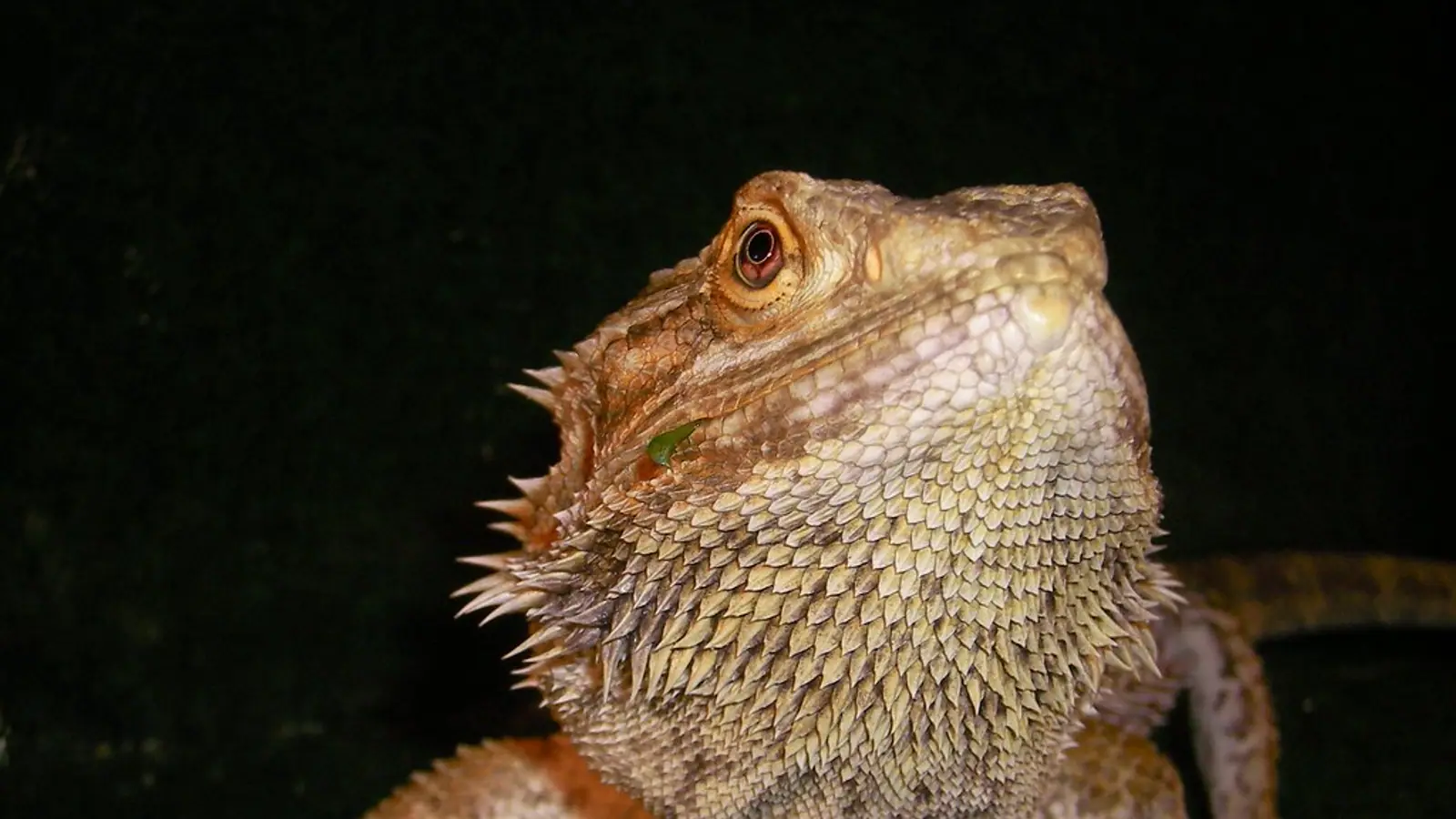
Look at the top of your bearded dragon's head, roughly between and slightly behind the eyes. There is a small, pale, translucent scale there. Under it sits the parietal eye.
The documented description: Lizards have a parietal 'third eye' atop the head with a primitive retina and photoreceptor cells; it detects changes in light and dark and helps regulate hormone production (circadian/thermoregulatory function)
That phrasing matters. A primitive retina and photoreceptors mean this is genuinely an eye in the anatomical sense, not a metaphor or a marketing term from the reptile hobby. It connects to the pineal region of the brain rather than to the visual cortex, which is why what it does differs so much from what the paired eyes do.
What it can and cannot do
It can: detect light levels, register changes between light and dark, and pick up a shadow passing overhead.
It cannot: form an image, resolve detail, or perceive colour the way the main eyes do.
The practical consequence is a fast overhead-threat detector. A shadow crossing the sensor is the signature of a bird, and in the arid Australian habitat this species evolved in, that is the most consequential shadow there is: Wide range of arid to semi-arid habitats: deserts, dry forests, scrublands, low open woodland and low shrubland; semiarboreal.
This is why a hand descending from above unsettles a dragon that is perfectly relaxed about a hand approaching from the side. You are triggering a system built for exactly that shape of event, which the handling guide turns into practical technique.
The daily clock function
The second job is timekeeping. Light detected by the parietal eye feeds into the regulation of daily rhythms, and bearded dragons are firmly daytime animals: Diurnal - active during the day
That is the one place where this anatomy has a direct husbandry implication. A consistent light cycle is not decoration: Provide a regular day-night light cycle: RSPCA UK and RSPCA SA recommend 12 hours light / 12 hours dark; NCSU: 12-14 hours light in spring/summer and 8 hours in fall/winter; PetMD: 10-12 hours UVB daily; Merck: 12 hours/day suitable for general maintenance.
And it should run without depending on your memory: Lighting should run on a consistent schedule (timer-controlled day-night cycle)
A dragon whose lights come on at random hours has a disrupted internal clock, and the organ receiving that signal is on top of its head. The UVB lighting guide covers scheduling.
Seasonal light changes feed into a bigger rhythm as well: During cooler seasons bearded dragons slow down, sleep more and eat less (brumation)
What the research showed
The parietal eye has been studied well beyond the reptile hobby, because it offers a window into how vision evolved. Work on lizard third eyes has examined how its photoreceptors respond to light, and the findings inform how scientists think image-forming vision developed from simpler light detection.
The main eyes of diurnal lizards are separately interesting: Diurnal lizards share a highly conserved ancestral pattern of four spectrally distinct cone classes (UV-, short-, medium- and long-wavelength sensitive), suggesting tetrachromatic colour vision extending into ultraviolet.
So a bearded dragon is running two visual systems at once: a sophisticated colour-capable pair of eyes facing forward and sideways, and an ancient light sensor pointing up. That combination is more unusual than it sounds, and it is a large part of why this species keeps turning up in comparative biology research. The same goes for its sleep: Bearded dragons show both REM and slow-wave sleep (first demonstrated in a reptile; Shein-Idelson et al., Science 352:590, 2016). Sleep cycle is ~80 seconds at 27 C (vs ~30 min in cats, 60-90 min in humans), with the two phases of roughly equal duration.
Do not cover it, and do not worry about it
A few practical points come up regularly.
No, you cannot damage it by handling. Normal handling does not affect the parietal eye. Support the body properly and it is a non-issue: Support the whole body from underneath including fore and hind limbs; do not squeeze; RSPCA UK suggests about 10-15 minutes at a time as a safe handling period; over-handling is stressful.
No, it does not need cleaning. The scale over it sheds along with the rest of the head. What does need attention is stuck shed in general: Retained shed shrinks as it dries and can constrict circulation, especially on toes and tail tips; poor shedding on the feet can cut off blood supply and lead to loss of toes or tissue death requiring amputation.
Yes, it stays functional in adults. This is not a juvenile feature that closes over.
No, it is not a sign of a morph or a defect. Every bearded dragon has one, as do many other lizard species.
When the head area does need attention
The parietal eye itself rarely causes problems. The area around it can, and the signs are the general ones: Swollen, sunken, closed, or draining eyes are a reason to contact a veterinarian; eye infections are among the common conditions seen in bearded dragons.
A related note on shedding, since the head sheds too: Bearded dragons shed their skin in large pieces; before a shed the dragon looks dull as the old skin dries, then the skin should come off easily over a day or so.
And the rule that applies whenever a shed looks stuck: Never pull off old skin that seems stuck - it can tear the new skin underneath.
The shedding guide and the eye problems guide cover both properly.
Other senses worth knowing about
The third eye fits into a broader sensory picture that explains a good deal of bearded dragon behaviour.
Hearing: Lizards have external ears (visible ear openings rather than protruding ears) and appear to hear better than snakes.
Colour and temperature: Bearded dragons regulate body temperature partly by changing shades of skin colour.
Body temperature governs everything: Preferred body temperature in the high thirties to low forties Celsius; thermal gradient of 27-45 C recommended in captivity.
Put together, you have an animal that senses overhead movement above it, reads its own temperature constantly, sees colour well, and hears without external ears. The behavior section covers how all of that translates into the signals owners actually see.
Quick reference
| Question | Answer |
|---|---|
| Is it a real eye? | Anatomically yes, with a primitive retina and photoreceptors |
| Can it see images? | No, it detects light, dark, and shadow |
| What is it for? | Overhead threat detection and daily rhythm regulation |
| Where is it? | Under a pale scale on top of the head |
| Does it affect care? | Only through keeping a consistent light cycle |
Source note: parietal eye anatomy and vision research from Rockefeller University and the Journal of Experimental Biology, with husbandry guidance from RSPCA care sheets, cited below.