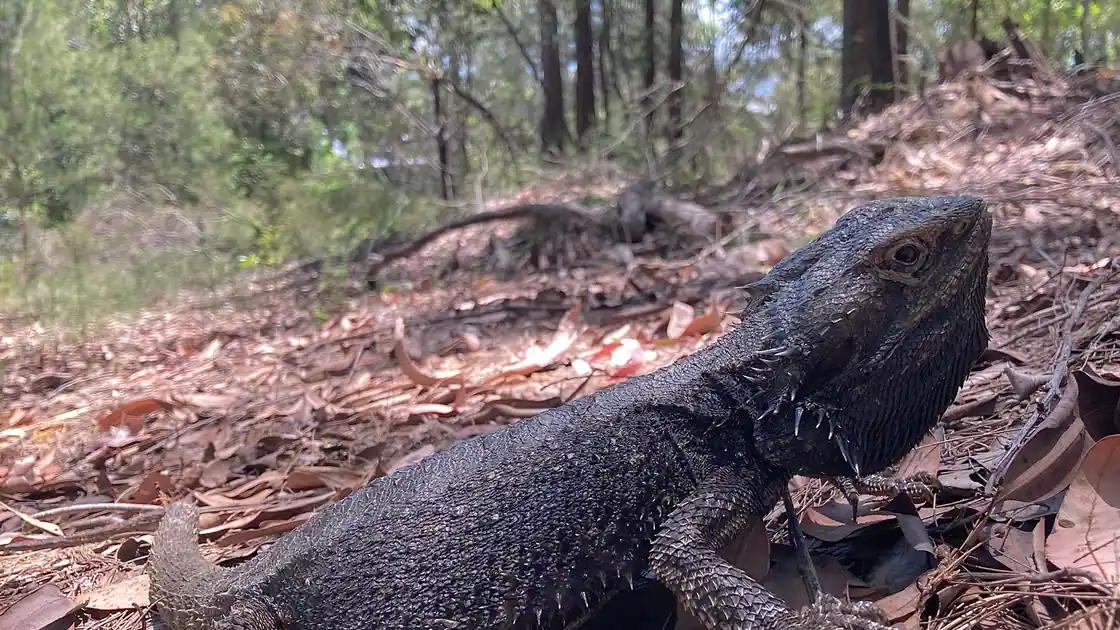
The documented differences
The features that separate the sexes are specific: Adult males have larger femoral pores on the underside of the thighs, larger heads, darker beards and slightly larger bodies than females; males are also more brightly colored.
Three of those are usable by an owner at home, and one is a job for a vet. Take them in order of practicality.
Femoral pores
Run your eye along the underside of the thighs, on a line between the back legs. You are looking for a row of small circular openings.
Males have noticeably larger, more prominent pores, often with a waxy secretion visible in mature animals. Females have them too, but smaller and flatter.
This is the easiest indicator for a settled dragon that tolerates being turned over briefly, and it improves with maturity: Sexual maturity at 1-2 years of age; some individuals mature as early as 6 months.
The handling itself matters, since a dragon on its back is in a vulnerable position: Support the whole body from underneath including fore and hind limbs; do not squeeze; RSPCA UK suggests about 10-15 minutes at a time as a safe handling period; over-handling is stressful.
Keep it brief, support the body, and stop if you see stress signals: When threatened they flatten the body and enlarge the throat, which can turn black.
Hemipenal bulges
Male bearded dragons have paired hemipenes stored inside the tail base. In a mature male, this produces two distinct bulges just behind the vent, separated by a slight groove. Females typically show a single, more central and less defined swelling, or none.
The common shortcut of shining a torch through the tail base is widely described in the hobby. We include it with a caveat: none of our cited veterinary sources documents that method or its reliability, so treat it as hobby practice rather than veterinary guidance, and never press or bend the tail. This species cannot regrow a damaged tail: Bearded dragons (Pogona) lack tail autotomy: in a peer-reviewed review of agamid autotomy, all examined specimens of P. barbata and P. vitticeps had intact tails and no literature documents pseudoautotomy in these species; a lost or amputated tail is permanent.
Head, body, and beard
Mature males tend toward larger, broader heads and darker beard displays. The behavioural difference is documented: Both sexes have a beard and can display it, but males display more frequently, especially in courtship.
So a dragon displaying frequently and dramatically is more likely male, and a female that displays is not unusual. Head shape and display frequency are supporting evidence rather than proof. The black beard guide covers displays properly.
Why age matters so much
The caution is explicit: Sexing bearded dragons under three months of age is very challenging; sex differences become clear as animals mature.
Under three months, all the physical markers are underdeveloped. Pores are barely formed, hemipenal bulges are not yet distinct, and head proportions have not diverged. A confident sexing of a hatchling is a guess dressed as an answer, which is why pet stores get it wrong so often.
Wait until the dragon is at least three to four months old, and expect real confidence closer to sexual maturity: 1 to 2 years
The part that makes this genuinely strange
Bearded dragons have a sex determination system with a twist that most owners never hear about.
The genetic basis: P. vitticeps has genotypic sex determination with a ZZ/ZW female-heterogametic sex chromosome system.
And the twist: Incubation temperatures at or above 32 C can cause complete phenotypic feminisation (sex reversal) of genetically male (ZZ) embryos; P. vitticeps is one of only two reptile species known to show thermally triggered sex reversal in wild populations (Holleley et al. 2015, Nature)
Read that carefully. Incubation temperature can override genetic sex, producing an animal that is genetically male by chromosome and functionally female in body. Sex-reversed females occur in this species and can reproduce.
So a dragon's sex is not always recoverable from a physical examination in the way you might assume, and genetic sex and physical sex can differ. It also means a female that lays eggs is definitively female in the way that matters practically, whatever her chromosomes say. Our facts section covers more of this species' biology.
Why the answer matters practically
Sexing is not trivia. Three practical consequences follow.
Housing. Never keep more than one adult male per enclosure - males are territorial and will fight; adult females kept together also require monitoring for aggression.
The general rule stands regardless of sex: House bearded dragons individually: RSPCA SA states they 'can inflict severe damage to each other, resulting in loss of limbs and even death' and that keeping multiple females together 'is not a safe practice and is best to avoid'; RSPCA UK: 'it's best to house bearded dragons separately'.
The cohabitation guide covers it.
Egg-laying. A female can produce eggs without ever meeting a male: Females can lay unfertilized eggs regardless of whether a male is present.
The clutch sizes involved are substantial: Females lay up to 24 eggs per clutch and up to 9 clutches per year (ADW); Australian Museum gives clutch sizes of 11-30 eggs; PetMD gives clutches of up to 20 eggs, multiple per year.
That carries a real health risk: Egg binding (dystocia) is life-threatening: gravid females stop eating and become sick, lethargic, or unresponsive; causes include inadequate UV lighting, temperature, humidity, malnutrition, obstruction, or reproductive tract abnormality - see a vet immediately.
An owner who believes their female is male will not recognise egg-related behaviour, including digging: Digging is a natural behavior; captive enclosures should provide substrate that allows it. The digging guide covers nesting behaviour.
Naming, which matters least. Our names guide has a unisex section for exactly this reason.
When to ask a vet
A reptile veterinarian can sex a dragon reliably and will often do it during a routine visit: Healthy bearded dragons should have a veterinary wellness examination once every year, ideally bringing a fresh fecal sample for parasite screening; regular annual checkups plus proper environment help catch and prevent illness early.
That is the answer for anyone uncertain, and particularly for anyone about to make a housing decision based on the result.
Quick reference
| Feature | Male | Female |
|---|---|---|
| Femoral pores | Larger, prominent, often waxy | Smaller, flatter |
| Tail base | Two distinct bulges | Single or minimal swelling |
| Head | Broader, larger | Narrower, more tapered |
| Beard display | More frequent and dramatic | Present but less frequent |
| Reliable from | Around 3 to 4 months, best near maturity | Same |
Source note: dimorphism and sexing guidance from Animal Diversity Web and VCA; sex reversal research from peer-reviewed literature cited below.