Species and morphs are not the same thing
The confusion is understandable, because sellers use the word type for both. A species is a natural population that evolved in the wild. A morph is a trait selected by breeders inside a species.
A German giant, a hypo, and a leatherback are all the same species. A Rankin's dragon is not. That distinction changes what you should expect on size, care, and price.
The species of the genus Pogona
The count itself carries a disagreement between sources, which we show rather than resolve arbitrarily.
Six naturally occurring species in genus Pogona, plus one viable captive-bred hybrid (Pogona vittikens, Rankin's dragon x central bearded dragon)
Some veterinary sources cite eight rather than six. Taxonomic counts shift as populations are reclassified, and the discrepancy is real rather than an error on anyone's part. The Animal Diversity Web figure of six is the one we use as our primary count, since it comes from a university-maintained taxonomic database.
The list: Pogona barbata (eastern), P. henrylawsoni (Rankin's), P. microlepidota (Kimberley), P. nullarbor (Nullarbor), P. vitticeps (central), P. minor (western)
All of them share a home region: The genus Pogona is native to the Australian region, with ranges across most of the continent excluding the central north and some southeastern coastal areas.
And the taxonomy: Class Reptilia, Order Squamata, Family Agamidae, Genus Pogona.
The one you almost certainly have
The inland/central bearded dragon (Pogona vitticeps) is the most popular pet species; commonly bred in captivity in the US and Canada.
The central or inland bearded dragon dominates captivity for practical reasons: it tolerates handling well, breeds readily in captivity, reaches a manageable size, and had a founding population outside Australia before exports closed.
Its range in the wild: P. vitticeps occurs from the eastern half of southern Australia to the southeastern Northern Territory; a band across the semi-arid interior of eastern Australia including western NSW, western Queensland and the Riverina.
And its habitat: Wide range of arid to semi-arid habitats: deserts, dry forests, scrublands, low open woodland and low shrubland; semiarboreal.
Rankin's dragon, the other one people keep
Pogona henrylawsoni appears in the trade often enough to mention, usually sold as a Rankin's or Lawson's dragon. It is a genuinely different species rather than a morph, and it is smaller than the central bearded dragon.
We are limited in what we can say beyond that, because our sources cover Pogona vitticeps in far more detail than its relatives. Anyone considering a Rankin's should seek species-specific husbandry guidance rather than assuming the care sheets on this site transfer exactly. Most of the principles do; the specifics on enclosure size in particular may not.
Why no wild-type dragons enter the trade
Australia banned the commercial export of all live native animals in 1982; pet-trade bearded dragons outside Australia today are supplied by overseas captive breeding.
Every bearded dragon in a home outside Australia descends from stock that left before that ban, bred in captivity ever since. This has one interesting consequence for the types question: the captive population is a genetically narrow slice of the wild species, which is the background against which morph breeding happened.
Illegal trade in Australian reptiles does still occur, which researchers have documented, though it is not the source of ordinary pet dragons.
What a wild-type dragon looks like
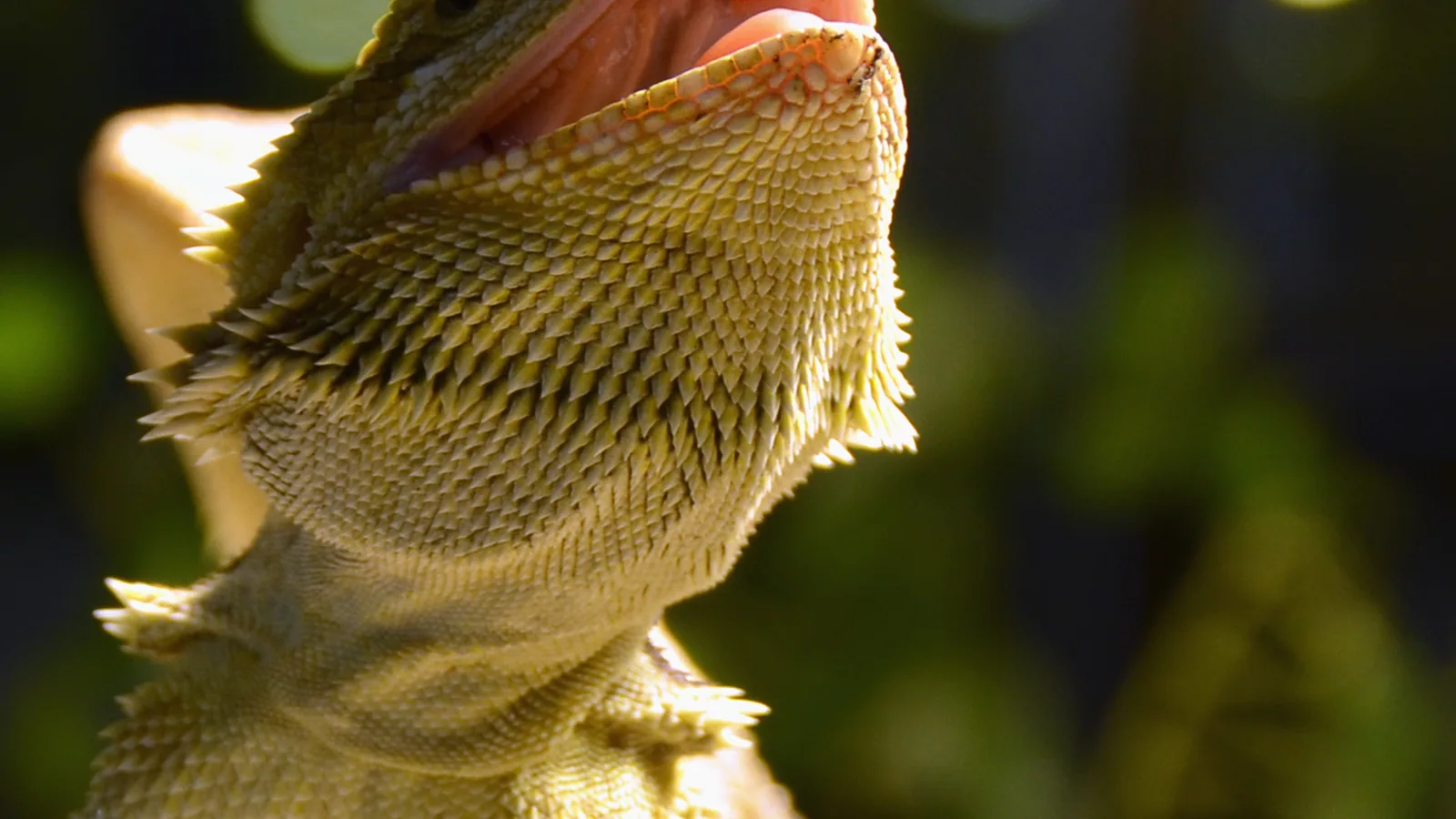
Useful as a baseline for judging morphs: Broad triangular head, flattened low wide body, stout legs, robust tail; spiny scales along the flanks and an expandable 'beard' throat pouch with spiky scales.
And colouring: Dull brown to tan with red or gold highlights; shades of red, brown and yellow that tend to match local soil color; yellow around eyes and sides of head.
Colour also has a function beyond appearance: Bearded dragons regulate body temperature partly by changing shades of skin colour.
That is a point breeders rarely raise. Skin colour in this species is partly a thermoregulatory tool, so selecting hard for pale colouration is selecting on a trait with a job.
Morphs: the actual variety in the trade
Everything else sold as a type is a morph within Pogona vitticeps. The best-documented ones affect scales rather than colour: The leatherback/silkback scalation trait shows incomplete dominance; the causal gene is ectodysplasin-A (EDA), identified by Di-Poi & Milinkovitch (Science Advances, 2016) - the same gene whose mutations disrupt hair, teeth, gland and nail development in humans and mice
The two ends of that trait: Leatherback: one copy of the scalation mutant allele (heterozygote); scales of reduced prominence/size - a smoother look with minimal tubercles; breeder description: one row of spikes retained on each side of the body plus beard/head spikes and Silkback: two copies of the mutant allele (homozygote); completely scaleless with no tubercles or lateral spines; very thin, damage-sensitive skin and more vibrant coloration
One of them carries a documented welfare cost: Silkbacks lose evaporative water at roughly twice the rate of wild-type bearded dragons, and leatherbacks are intermediate (closer to silkbacks); the morphs do not adjust their thermal preferences to compensate
Colour and pattern morphs include hypomelanistic (Hypomelanistic ('hypo'): reduced melanin producing more vibrant/pastel colors and clear nails lacking the usual brown melanin stripe; recessive mutation), translucent (Translucent ('trans'): partially see-through skin and solid black eyes; hatchlings often show blue underbellies; recessive mutation), zero (Zero: completely patternless morph in silvery off-white to darker silver/gray shades; recessive mutation), and witblits (Witblits: patternless morph in muted earth tones to sandy orange; recessive mutation, distinct from zero).
Each has its own guide: leatherback, hypo, translucent, and zero.
Size does not vary by morph
A common sales claim worth defusing. Adult size is a species characteristic: Adults roughly 33-61 cm (13-24 in) total length including tail; VCA gives 45-56 cm (18-22 in); Australian Museum gives up to 55 cm; about half the length is tail.
Weight: 250 to 510 grams
German giant is a size line rather than a genetic morph in the way leatherback is, and our sources do not document it as a distinct genetic trait. Treat size claims from sellers with the scepticism you would apply to any unverifiable marketing. The size guide covers documented growth.
Care is the same across morphs
| Type | Care implications |
|---|---|
| Central bearded dragon, wild-type | The standard covered across this site |
| Colour morphs, hypo, translucent, zero | Identical husbandry |
| Leatherback | Identical husbandry |
| Silkback | Additional needs from water loss and skin fragility |
| Other Pogona species | Seek species-specific guidance |
Source note: species data from Animal Diversity Web and the Australian Museum; morph genetics from University of Geneva research and the Journal of Experimental Biology, cited below.
Whatever type you have, the habitat section and care section apply. Colour changes nothing about a basking zone at 95 to 110 F (35 to 43 C).