What translucent means
The description from breeder sources: Translucent ('trans'): partially see-through skin and solid black eyes; hatchlings often show blue underbellies; recessive mutation
Two features define the morph. Skin that transmits light more than a normal dragon's, giving a slightly ethereal quality especially around the spikes and belly. And solid black eyes, without the visible iris pattern of a standard dragon.
The eyes are the reliable marker. Skin translucency varies between individuals and fades as a dragon matures, while the black eyes stay.
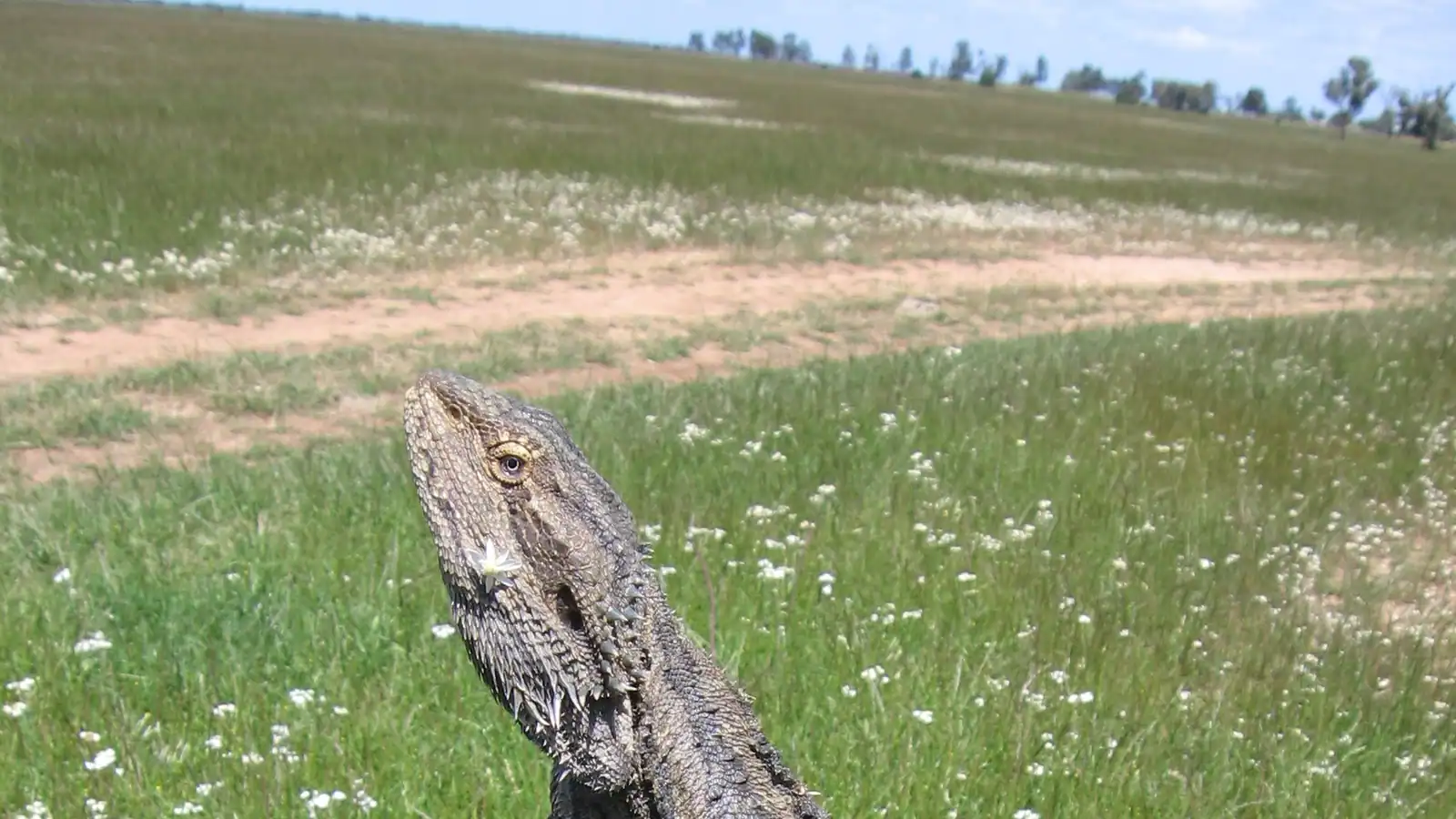
For comparison, a wild-type dragon: Broad triangular head, flattened low wide body, stout legs, robust tail; spiny scales along the flanks and an expandable 'beard' throat pouch with spiky scales.
Why hatchlings look most dramatic
The translucent effect is strongest in young animals, and it becomes more subtle as the dragon grows and its skin thickens. Photographs that sell the morph are usually of hatchlings.
That is not deception, and it is worth knowing before you buy. An adult translucent looks like a bearded dragon with unusually dark eyes and slightly luminous skin, rather than the near-transparent creature in a hatchling photo.
Growth to adult proportions happens over the first year or two: 1 to 2 years Adult size for the species is 45 to 60 cm (about 18 to 24 inches), which the size guide covers.
The genetics, described honestly
Breeders treat translucent as a recessive trait, meaning both parents must carry it for offspring to display it. A dragon carrying one copy without showing the trait is described as het trans.
Unlike the scale morphs, translucency lacks peer-reviewed genetic characterisation in the sources we cite. The scale trait has it: The leatherback/silkback scalation trait shows incomplete dominance; the causal gene is ectodysplasin-A (EDA), identified by Di-Poi & Milinkovitch (Science Advances, 2016) - the same gene whose mutations disrupt hair, teeth, gland and nail development in humans and mice
So we report breeder convention as breeder convention. That is the honest position rather than presenting hobby genetics with the same confidence as published research.
Does translucency affect health?
No documented welfare cost for translucency appears in our sources. That distinguishes it clearly from the scaleless silkback: Silkbacks lose evaporative water at roughly twice the rate of wild-type bearded dragons, and leatherbacks are intermediate (closer to silkbacks); the morphs do not adjust their thermal preferences to compensate
One question owners ask sensibly: do the black eyes affect vision or light sensitivity? None of our cited sources addresses that, so we will not speculate. What is documented about this species' vision generally: Diurnal lizards share a highly conserved ancestral pattern of four spectrally distinct cone classes (UV-, short-, medium- and long-wavelength sensitive), suggesting tetrachromatic colour vision extending into ultraviolet.
And the light-sensing organ on top of the head, which is present in every dragon: Lizards have a parietal 'third eye' atop the head with a primitive retina and photoreceptor cells; it detects changes in light and dark and helps regulate hormone production (circadian/thermoregulatory function)
If you want to be cautious, a well-designed enclosure already provides the answer. Shade is a requirement for every bearded dragon regardless of morph: Provide hiding places at BOTH the warm and cool ends of the enclosure; hides can be commercial caves, clay pots or cardboard boxes.
A dragon with hides at both ends can regulate its own light exposure, which is what the tank decor guide covers.
Genetics appear among documented lifespan factors in this species, which is a general note rather than a translucent-specific one: Factors that shorten lifespan include inbreeding/genetic issues (e.g., silkback morphs with compromised skin), poor husbandry, metabolic bone disease, kidney disease, dental disease, obesity, retained eggs, and lack of veterinary care.
Care requirements
Identical to any bearded dragon.
Enclosure: 40 gallons at minimum, with 60 to 100 gallons widely recommended, or in metric at least 120 cm long by 60 cm wide by 60 cm high
Basking zone: 95 to 110 F (35 to 43 C)
Cool end: 75 to 80 F (24 to 27 C)
Night: no colder than 65 to 70 F (18 to 21 C)
UVB: Provide a regular day-night light cycle: RSPCA UK and RSPCA SA recommend 12 hours light / 12 hours dark; NCSU: 12-14 hours light in spring/summer and 8 hours in fall/winter; PetMD: 10-12 hours UVB daily; Merck: 12 hours/day suitable for general maintenance., replaced every 6 to 12 months
Humidity: 30 to 40 percent
Diet: the age-based structure covered in the food section
The habitat section covers the full setup, and none of it changes for a translucent dragon.
Reading a translucent dragon's signals
One small practical difference. Beard displays are still perfectly visible, since the beard darkens regardless of the morph: The beard turns dark to jet black and inflates during displays; used in both threat/aggression and courtship. When threatened, the dragon faces the intruder with mouth wide open and beard puffed out; darkening also occurs with stress, fear or mating arousal.
Both sexes display: Both sexes have a beard and can display it, but males display more frequently, especially in courtship.
What can be marginally harder is judging overall body colour changes for stress, since translucent skin reads differently from normal scaling under a lamp. Watch posture and behaviour alongside colour, which the body language guide covers.
Combination morphs
Translucent stacks with other traits, and listings often combine several:
Hypo translucent combines reduced melanin with translucency: Hypomelanistic ('hypo'): reduced melanin producing more vibrant/pastel colors and clear nails lacking the usual brown melanin stripe; recessive mutation
Zero is a separate patternless trait: Zero: completely patternless morph in silvery off-white to darker silver/gray shades; recessive mutation
Witblits is another patternless line: Witblits: patternless morph in muted earth tones to sandy orange; recessive mutation, distinct from zero
Leatherback translucent adds the scale trait: Leatherback: one copy of the scalation mutant allele (heterozygote); scales of reduced prominence/size - a smoother look with minimal tubercles; breeder description: one row of spikes retained on each side of the body plus beard/head spikes
That last combination deserves attention for the reason covered in the leatherback guide: Breeding leatherback x leatherback yields approximately 25% normal-scaled, 50% leatherback, 25% silkback offspring (classic incomplete-dominance ratio); no hidden 'het' carriers - the trait is always visible
Ask any breeder selling leatherback combinations what happened to the silkbacks in the clutch. The answer tells you a great deal.
Buying a translucent dragon
Health first, appearance second. The baseline: A healthy bearded dragon is alert, active, and aware, with clear bright eyes, a thick round tail base, hips that do not protrude, a clean dry vent, bright pink mouth tissue, and clear saliva.
And what to reject: Signs of an unhealthy dragon include a skinny appearance or loose skin, sunken eyes, lethargy or inactivity, a sunken bony tail, wet or soiled vent, cloudy mucus or cottage-cheese-like material in the mouth, and gum redness or pinpoint hemorrhages.
Ask to see the parents if possible, ask about the clutch, and ask what the animal has been eating. Then arrange the first veterinary check: A reptile-experienced veterinarian should examine a new bearded dragon within 48 hours of purchase (physical exam, weight, oral cavity, skeletal evaluation, fecal parasite test)
The health check guide and the buying guide cover the process.
Quick reference
| Feature | Translucent |
|---|---|
| Skin | Partially see-through, strongest in hatchlings |
| Eyes | Solid black without visible iris pattern |
| Inheritance | Recessive, per breeder convention |
| Documented welfare cost | None in our sources |
| Care | Identical to any bearded dragon |
Source note: morph descriptions from breeder sources, labeled as such; vision research and husbandry facts from the Journal of Experimental Biology, Rockefeller University, and RSPCA guidance cited below.