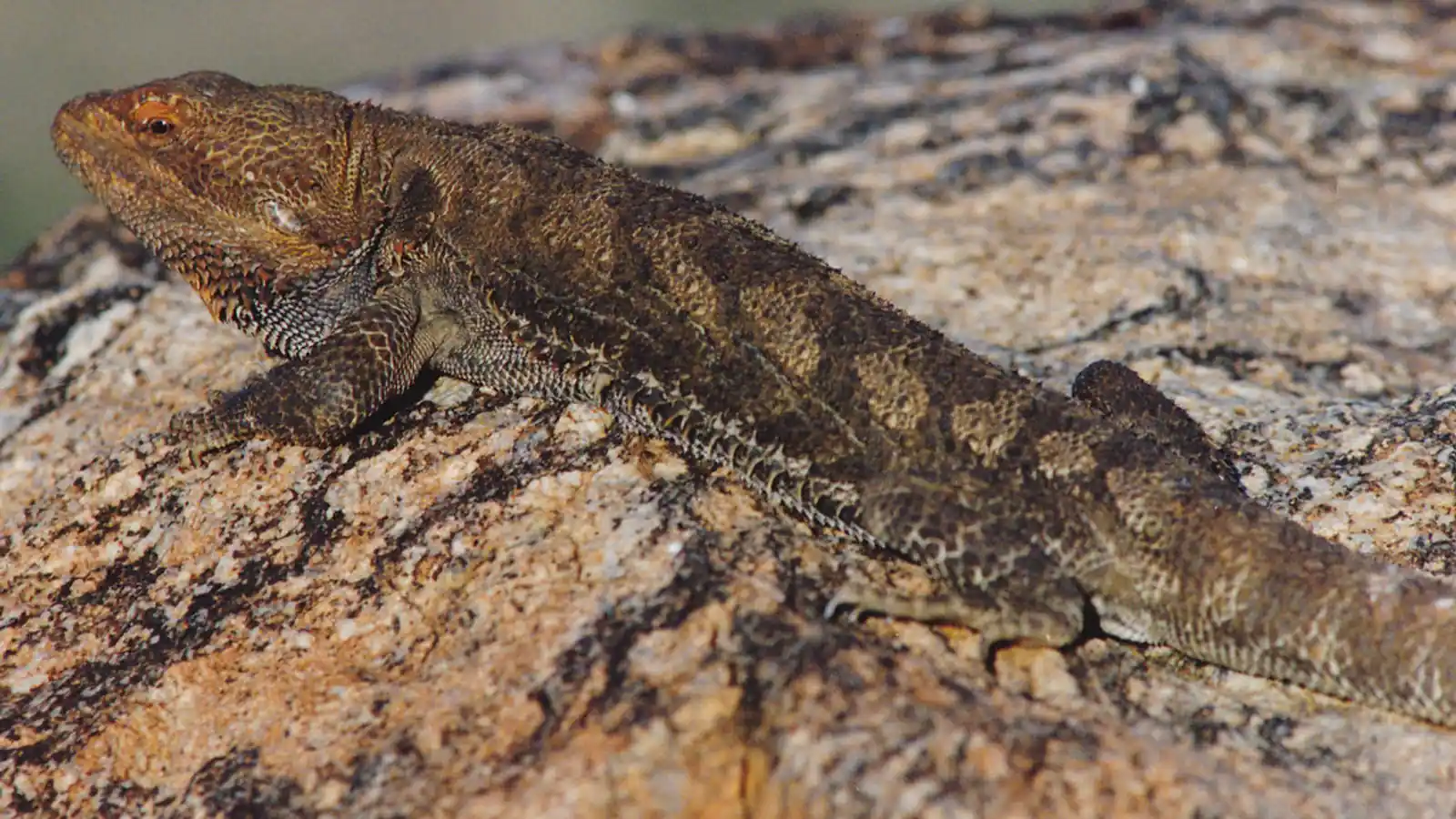
What a leatherback is
The genetic description: Leatherback: one copy of the scalation mutant allele (heterozygote); scales of reduced prominence/size - a smoother look with minimal tubercles; breeder description: one row of spikes retained on each side of the body plus beard/head spikes
In plain terms, a leatherback has one copy of a mutation affecting scale development. The spiny scales along the sides and back are reduced, the skin looks smoother, and colours tend to appear more vivid because there is less scale texture breaking up the surface.
Compare that with the wild-type animal: Broad triangular head, flattened low wide body, stout legs, robust tail; spiny scales along the flanks and an expandable 'beard' throat pouch with spiky scales.
And wild-type colouring: Dull brown to tan with red or gold highlights; shades of red, brown and yellow that tend to match local soil color; yellow around eyes and sides of head.
The genetics, which are unusually well documented
This is one of the few morph traits with proper scientific backing rather than breeder folklore: The leatherback/silkback scalation trait shows incomplete dominance; the causal gene is ectodysplasin-A (EDA), identified by Di-Poi & Milinkovitch (Science Advances, 2016) - the same gene whose mutations disrupt hair, teeth, gland and nail development in humans and mice
The causal gene is ectodysplasin-A, identified through research at the University of Geneva. That gene is involved in skin appendage development across vertebrates, which is why the finding attracted attention well beyond reptile keeping.
Incomplete dominance is the key term. One copy gives you a leatherback. Two copies do not give you a more extreme leatherback in a mild sense; they give you a different animal entirely.
The breeding outcome that matters
Here is the arithmetic every buyer and breeder should know: Breeding leatherback x leatherback yields approximately 25% normal-scaled, 50% leatherback, 25% silkback offspring (classic incomplete-dominance ratio); no hidden 'het' carriers - the trait is always visible
A quarter of the offspring from two leatherbacks are silkbacks. That is not an accident or a bad batch. It is the predictable outcome of the genetics, and it is the reason this page spends as much time on silkbacks as on leatherbacks.
Silkbacks and the welfare evidence
Silkback: two copies of the mutant allele (homozygote); completely scaleless with no tubercles or lateral spines; very thin, damage-sensitive skin and more vibrant coloration
And the measured consequence: Silkbacks lose evaporative water at roughly twice the rate of wild-type bearded dragons, and leatherbacks are intermediate (closer to silkbacks); the morphs do not adjust their thermal preferences to compensate
That figure comes from a peer-reviewed study in the Journal of Experimental Biology, not from a forum argument. Roughly double the evaporative water loss, in a species evolved for arid country: Wide range of arid to semi-arid habitats: deserts, dry forests, scrublands, low open woodland and low shrubland; semiarboreal.
The practical implications compound. A scaleless dragon dehydrates faster, needs more careful humidity management against a target of 30 to 40 percent, and has skin with no protective armour against ordinary enclosure furniture: Provide sturdy basking furniture: large climbable rocks and secured low branches; RSPCA SA calls thick branches, rocks, hollows, basking sites and climbing facilities 'essential to minimise stress and provide choice for self-regulation and environmental enrichment'.
Genetic factors are also documented among the things that shorten lifespan in this species: Factors that shorten lifespan include inbreeding/genetic issues (e.g., silkback morphs with compromised skin), poor husbandry, metabolic bone disease, kidney disease, dental disease, obesity, retained eggs, and lack of veterinary care.
Our position, stated plainly: we do not recommend deliberately breeding or buying silkbacks. Leatherbacks are a different matter, since a single copy of the allele carries no documented welfare cost.
Caring for a leatherback
The good news is that there is nothing special to do. A leatherback needs the same husbandry as any bearded dragon.
Temperatures: basking at 95 to 110 F (35 to 43 C), cool end 75 to 80 F (24 to 27 C), night no colder than 65 to 70 F (18 to 21 C)
UVB: Bearded dragons rely on UVB light to synthesize vitamin D3 in the skin; D3 is essential for calcium metabolism, and without adequate UVB they can develop metabolic bone disease (nutritional secondary hyperparathyroidism), weak bones and fractures. on the standard schedule, replaced every 6 to 12 months
Humidity: 30 to 40 percent
Diet: the same age-based structure covered in the food section
Enclosure: 40 gallons at minimum, with 60 to 100 gallons widely recommended
One small practical note. Reduced scaling means slightly less physical protection, so sharp or rough decor deserves a second look. Secure, smooth-surfaced basking furniture is preferable to anything with edges.
Shedding is worth watching too, since skin structure differs: Bearded dragons shed their skin in large pieces; before a shed the dragon looks dull as the old skin dries, then the skin should come off easily over a day or so.
And the standing rule: Never pull off old skin that seems stuck - it can tear the new skin underneath.
Buying a leatherback
Questions worth asking a seller:
Are both parents leatherbacks? If so, silkbacks were produced in that clutch, and it is fair to ask what happened to them.
Is this animal a leatherback or a silkback? They are visually distinct once you know what to look for. A silkback has no scale texture at all.
What is the health history? The general assessment applies: A healthy bearded dragon is alert, active, and aware, with clear bright eyes, a thick round tail base, hips that do not protrude, a clean dry vent, bright pink mouth tissue, and clear saliva.
And the warning signs: Signs of an unhealthy dragon include a skinny appearance or loose skin, sunken eyes, lethargy or inactivity, a sunken bony tail, wet or soiled vent, cloudy mucus or cottage-cheese-like material in the mouth, and gum redness or pinpoint hemorrhages.
The health check guide covers assessment properly, and the buying guide covers where to look.
Morph animals typically cost more than standard dragons. Our setup cost guide covers pricing with real retailer figures, and makes the point that the animal is a small share of the total either way.
Quick reference
| Genotype | Result | Welfare status |
|---|---|---|
| No mutant allele | Normal scaled dragon | Standard |
| One copy | Leatherback, reduced scales | No documented cost |
| Two copies | Silkback, scaleless | Roughly double water loss |
Source note: scalation genetics from University of Geneva research; water-loss measurements from Sakich and Tattersall, Journal of Experimental Biology 2021; appearance descriptions from breeder sources, labeled as such, cited below.
The morphs section covers the colour traits, which work by entirely different mechanisms.