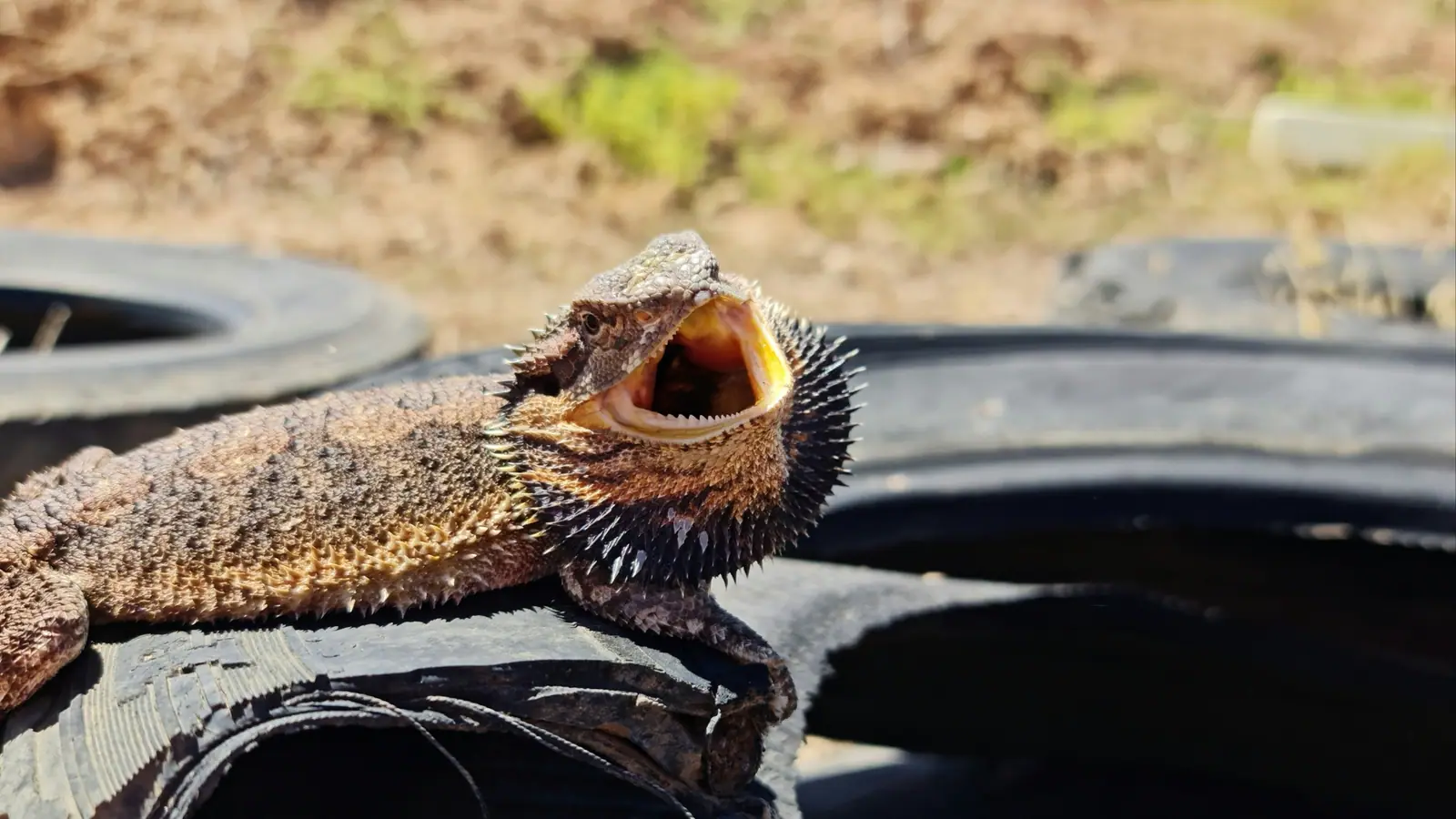
Adult size, from the sources
The documented figures: Adults roughly 33-61 cm (13-24 in) total length including tail; VCA gives 45-56 cm (18-22 in); Australian Museum gives up to 55 cm; about half the length is tail.
Weight follows: 250-510 grams.
Ranges rather than points, because sources measure differently and individuals vary. A dragon at the smaller end is not stunted, and one at the larger end is not exceptional.
One measurement note that trips people up: total length includes the tail, which is a substantial share of it. A dragon described as 24 inches is not 24 inches of body.
Where they start
Hatchlings are small: around 4 cm snout to vent snout to vent.
That is a striking difference from adult size, and the growth happens fast. Sexual maturity arrives at 1 to 2 years, with some individuals maturing as early as six months.
Most length is gained in the first year. Weight and bulk continue to build afterward.
Why we do not publish a monthly growth chart
Search this question and you will find tables giving expected length and weight for every month of a dragon's first year. They look authoritative and they are not sourced to veterinary literature.
We looked. None of the veterinary sources we cite publishes a month-by-month growth chart for Pogona vitticeps. What they publish is hatchling size, adult size, and the maturity timeline, which is what appears above.
We could copy a chart from elsewhere. We will not, because a number with no source behind it is exactly what this site exists to avoid, and because those charts cause real harm when an owner panics over a dragon tracking slightly below an invented line.
What to track instead
Trend beats target. Weigh your dragon weekly on a kitchen scale and write the number down. What matters is the direction of travel, not agreement with a chart.
Steady gain in a juvenile is what growth looks like.
A plateau in an adult is normal and expected.
Loss at any age is the signal that matters. The signs vets look for: Observable weight-loss signs in lizards include tail thinning (fat is stored in the tail), prominent ribs, and defined skull bones.
And the threshold for acting: Contact a veterinarian if a bearded dragon is lethargic, isn't eating well, or isn't growing normally (WSU); RSPCA advises watching weight and contacting a vet if a dragon loses weight during seasonal slowdown.
This matters because reptiles conceal illness: Reptiles typically do not show signs of illness until disease has significantly progressed, so subtle changes matter and owners should not wait to see if the lizard recovers on its own.
A weekly weight is the cheapest early warning system available, and the care routine guide builds it into the schedule.
What actually limits growth
A dragon that grows poorly usually has a husbandry explanation rather than a genetic one.
Temperature. Digestion runs on heat: Preferred body temperature in the high thirties to low forties Celsius; thermal gradient of 27-45 C recommended in captivity. A dragon that cannot reach 95 to 110 F (35 to 43 C) digests poorly and grows slowly, whatever it eats.
Diet composition by age. Juveniles need a very different balance from adults: Live insects should make up about 70% of a juvenile bearded dragon's diet, with vegetables about 20-30% and only small amounts of fruit. and hatchlings more so: Hatchlings and young juveniles (under 4 months) eat about 70% animal matter and 30% vegetable matter.
Feeding frequency. Hatchlings (under 1-2 months) should be fed 2-3 times daily, primarily appropriately sized live insects (flightless fruit flies, gut-loaded pinhead crickets, mashed vegetables)
Calcium and UVB. Skeletal growth depends on both: Juvenile bearded dragons are particularly vulnerable to metabolic bone disease; young and reproducing animals face higher risk.
Enclosure size. An undersized tank does not stunt growth directly, and it does prevent a proper thermal gradient, which affects everything above.
The feeding schedule guide covers the diet side, and the temperature guide covers heat.
Size and enclosure planning
This is the practical payoff of knowing adult size. A dragon reaching 45 to 60 cm (about 18 to 24 inches) needs an enclosure sized for that animal, not for the hatchling in front of you.
Requirements: 40 gallons at minimum, with 60 to 100 gallons widely recommended
And the metric version: at least 120 cm long by 60 cm wide by 60 cm high
The underlying rule: Enclosure length should be at least 3x the lizard's total body length; VCA adds minimum width of 16 inches.
An adult-sized enclosure bought first is usually cheaper than buying twice, which the setup cost guide covers with real prices. The tank size guide covers sizing by stage.
Do morphs or sex affect size?
Morphs: not meaningfully. Colour and scale morphs are traits within one species, and the morphs guide covers what they do change.
Sex: males tend to have broader heads and are often slightly larger overall: Adult males have larger femoral pores on the underside of the thighs, larger heads, darker beards and slightly larger bodies than females; males are also more brightly colored. The difference is modest rather than dramatic.
German giants: a size line marketed by breeders rather than a documented genetic morph in our sources. Treat size claims sceptically.
Other Pogona species: genuinely different. Rankin's dragons are smaller, and they are a separate species rather than a morph: Pogona barbata (eastern), P. henrylawsoni (Rankin's), P. microlepidota (Kimberley), P. nullarbor (Nullarbor), P. vitticeps (central), P. minor (western)
Obesity, the other size problem
Owners worry about dragons being too small. The commoner problem in captivity runs the other way, especially in adults fed like juveniles: Diet shifts with age: hatchlings/young juveniles eat roughly 70% insects / 30% vegetation, flipping in adulthood to mostly vegetation (RSPCA Australia: adults ~90% vegetation / 10% animal matter; PetMD: adults 70-80% plants)
And this is measurably widespread: A Tufts-affiliated survey of 405 bearded dragon owners found approximately half were feeding a diet with less than 50% plant material and more than 50% insects, and researchers noted a need for clear evidence-based nutritional guidelines on food type, quantity, and frequency.
An overweight dragon carries visible fat pads behind the eyes and at the tail base, and the fix is a diet correction toward the adult balance rather than a crash reduction. The feeding guide covers the transition.
Quick reference
| Stage | Size |
|---|---|
| Hatchling | around 4 cm snout to vent snout to vent |
| Sexual maturity | 1 to 2 years |
| Adult length | 45 to 60 cm (about 18 to 24 inches) including tail |
| Adult weight | 250 to 510 grams |
| Enclosure needed | 40 gallons at minimum, with 60 to 100 gallons widely recommended |
Source note: size and maturity data from Animal Diversity Web, VCA, and the Australian Museum; enclosure requirements from RSPCA care sheets, cited below.