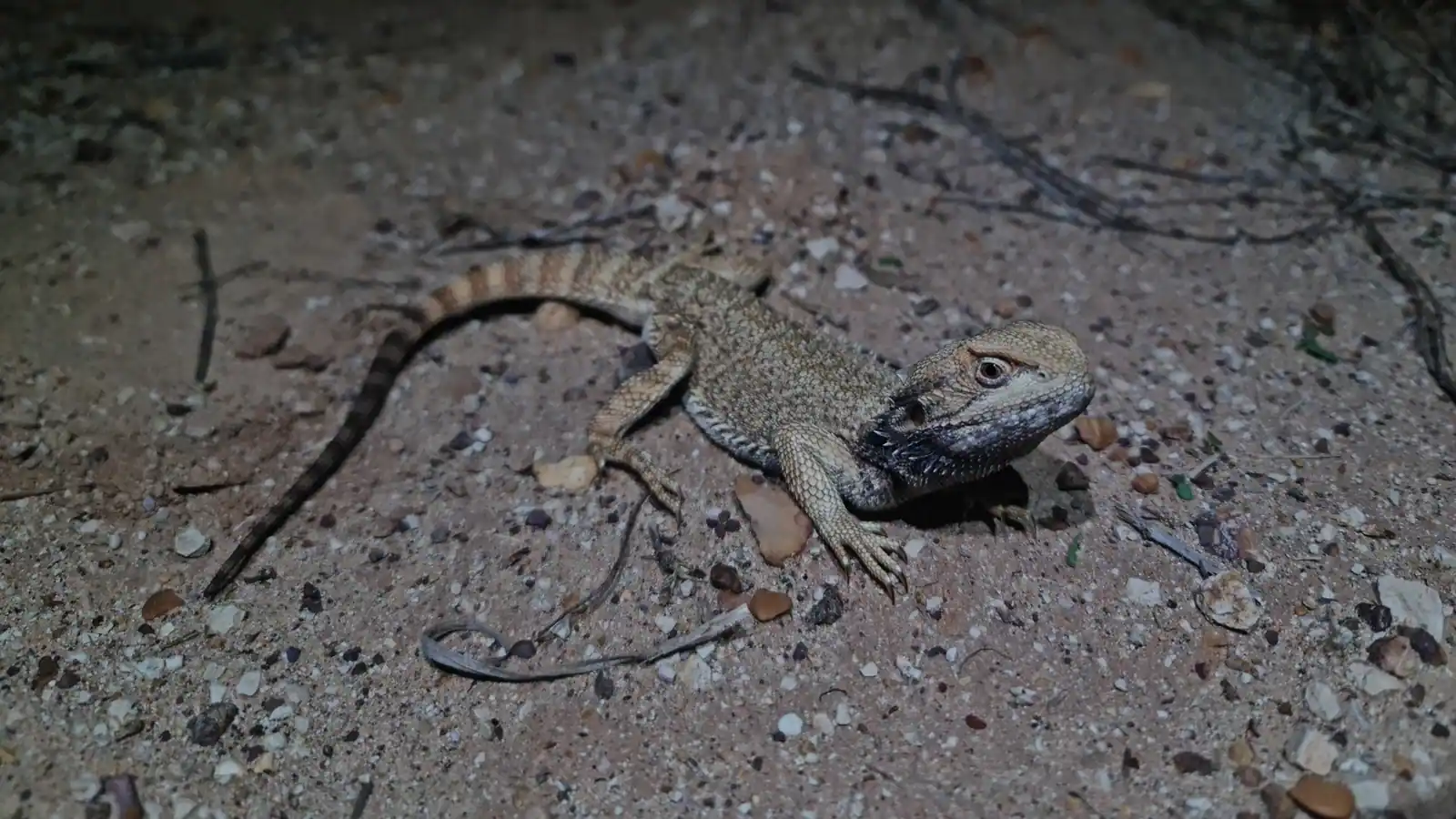
What hypo means
The description: Hypomelanistic ('hypo'): reduced melanin producing more vibrant/pastel colors and clear nails lacking the usual brown melanin stripe; recessive mutation
Hypomelanistic means reduced melanin, the pigment responsible for dark colouration. Less melanin produces lighter, cleaner colour: pastel oranges, soft yellows, and paler patterning against a background that would be duller in a wild-type dragon.
For comparison, the wild-type animal: Dull brown to tan with red or gold highlights; shades of red, brown and yellow that tend to match local soil color; yellow around eyes and sides of head.
Clear nails, the useful marker
The most practical way to identify a hypo is the nails. Reduced melanin shows in them clearly, producing translucent or clear claws rather than the dark ones a normal dragon has.
That is genuinely useful in a shop, because colour alone is unreliable. Bearded dragons change shade constantly for reasons that have nothing to do with genetics: Bearded dragons regulate body temperature partly by changing shades of skin colour.
A dragon that looks bright and pale under a hot basking lamp may look considerably darker in the morning. Nails do not change with temperature.
The clear-nail marker has a small practical bonus, since a visible quick makes nail work easier, though most dragons never need it: Most bearded dragons naturally wear down their nails and do not require regular trimming (PetMD)
The genetics
Hypo is a recessive trait, which has a straightforward consequence: both parents must carry the gene for offspring to display it. A dragon can carry one copy without showing it, which is what breeders mean by het hypo.
Unlike the scale morphs, hypo does not have peer-reviewed genetic characterisation in the sources we cite. The scale trait does: The leatherback/silkback scalation trait shows incomplete dominance; the causal gene is ectodysplasin-A (EDA), identified by Di-Poi & Milinkovitch (Science Advances, 2016) - the same gene whose mutations disrupt hair, teeth, gland and nail development in humans and mice
So we describe hypo genetics at the level breeders describe them, and label it that way rather than dressing breeder convention as science. The trait combines readily with others, which is where names like hypo translucent and hypo leatherback come from.
Does it affect health?
No documented welfare cost appears in our sources for hypomelanism, which puts it in a different category from the scaleless silkback: Silkbacks lose evaporative water at roughly twice the rate of wild-type bearded dragons, and leatherbacks are intermediate (closer to silkbacks); the morphs do not adjust their thermal preferences to compensate
That contrast is the useful frame. Some morphs carry measured consequences and some do not. Hypo belongs to the second group on current evidence.
One consideration is worth raising honestly rather than as a warning. Colour in this species has a job: Bearded dragons regulate body temperature partly by changing shades of skin colour.
Darker skin absorbs heat faster, so an animal bred for reduced pigment is an animal with less of that tool. No source we cite measures how much this matters in a captive dragon with a correct thermal gradient, and we are not going to invent a finding. A properly set-up enclosure with a basking zone at 95 to 110 F (35 to 43 C) and a cool end at 75 to 80 F (24 to 27 C) lets any dragon thermoregulate by moving, which is the primary mechanism anyway: A hot-to-cool temperature gradient is mandatory so the dragon can thermoregulate within its preferred optimal temperature zone (POTZ)
Genetics do appear among documented lifespan factors in this species: Factors that shorten lifespan include inbreeding/genetic issues (e.g., silkback morphs with compromised skin), poor husbandry, metabolic bone disease, kidney disease, dental disease, obesity, retained eggs, and lack of veterinary care.
Care for a hypo dragon
Identical to any bearded dragon, and that is the honest headline.
Enclosure: 40 gallons at minimum, with 60 to 100 gallons widely recommended
Temperatures: basking 95 to 110 F (35 to 43 C), cool end 75 to 80 F (24 to 27 C), night no colder than 65 to 70 F (18 to 21 C)
UVB: Provide a regular day-night light cycle: RSPCA UK and RSPCA SA recommend 12 hours light / 12 hours dark; NCSU: 12-14 hours light in spring/summer and 8 hours in fall/winter; PetMD: 10-12 hours UVB daily; Merck: 12 hours/day suitable for general maintenance., replaced every 6 to 12 months
Humidity: 30 to 40 percent
Diet: the age-based structure in the food section
One small observational note: colour changes are easier to read on a pale dragon. A darkening beard shows more clearly against light skin, which makes body language slightly easier to interpret: The beard turns dark to jet black and inflates during displays; used in both threat/aggression and courtship. When threatened, the dragon faces the intruder with mouth wide open and beard puffed out; darkening also occurs with stress, fear or mating arousal.
That is a modest advantage for a new owner learning to read their animal. The body language guide covers the vocabulary.
Hypo combinations you will see for sale
Breeders stack traits, so listings often combine several. The other single traits in our sources:
Translucent: Translucent ('trans'): partially see-through skin and solid black eyes; hatchlings often show blue underbellies; recessive mutation Covered in the translucent guide.
Zero: Zero: completely patternless morph in silvery off-white to darker silver/gray shades; recessive mutation Covered in the zero guide.
Witblits: Witblits: patternless morph in muted earth tones to sandy orange; recessive mutation, distinct from zero
Leatherback: Leatherback: one copy of the scalation mutant allele (heterozygote); scales of reduced prominence/size - a smoother look with minimal tubercles; breeder description: one row of spikes retained on each side of the body plus beard/head spikes Covered in the leatherback guide.
The combination that warrants real caution is anything producing a silkback, since two copies of the scale allele carry the documented water-loss cost.
Buying advice
Colour should be the last thing you assess, after health. The baseline: A healthy bearded dragon is alert, active, and aware, with clear bright eyes, a thick round tail base, hips that do not protrude, a clean dry vent, bright pink mouth tissue, and clear saliva.
And the warning signs: Signs of an unhealthy dragon include a skinny appearance or loose skin, sunken eyes, lethargy or inactivity, a sunken bony tail, wet or soiled vent, cloudy mucus or cottage-cheese-like material in the mouth, and gum redness or pinpoint hemorrhages.
A striking hypo with sunken eyes and a thin tail base is a worse purchase than a plain wild-type dragon in good condition. The health check guide covers the assessment, and the buying guide covers sources.
One more practical point: morph pricing varies enormously and the animal is a small share of what you will spend. The setup cost guide has the real numbers.
Quick reference
| Feature | Hypo |
|---|---|
| Pigment | Reduced melanin |
| Colour | Brighter, more pastel |
| Nails | Clear or translucent |
| Inheritance | Recessive, per breeder convention |
| Documented welfare cost | None in our sources |
| Care requirements | Identical to any bearded dragon |
Source note: morph descriptions from breeder sources, labeled as such; thermoregulation and husbandry facts from Animal Diversity Web, RSPCA, and veterinary sources cited below.