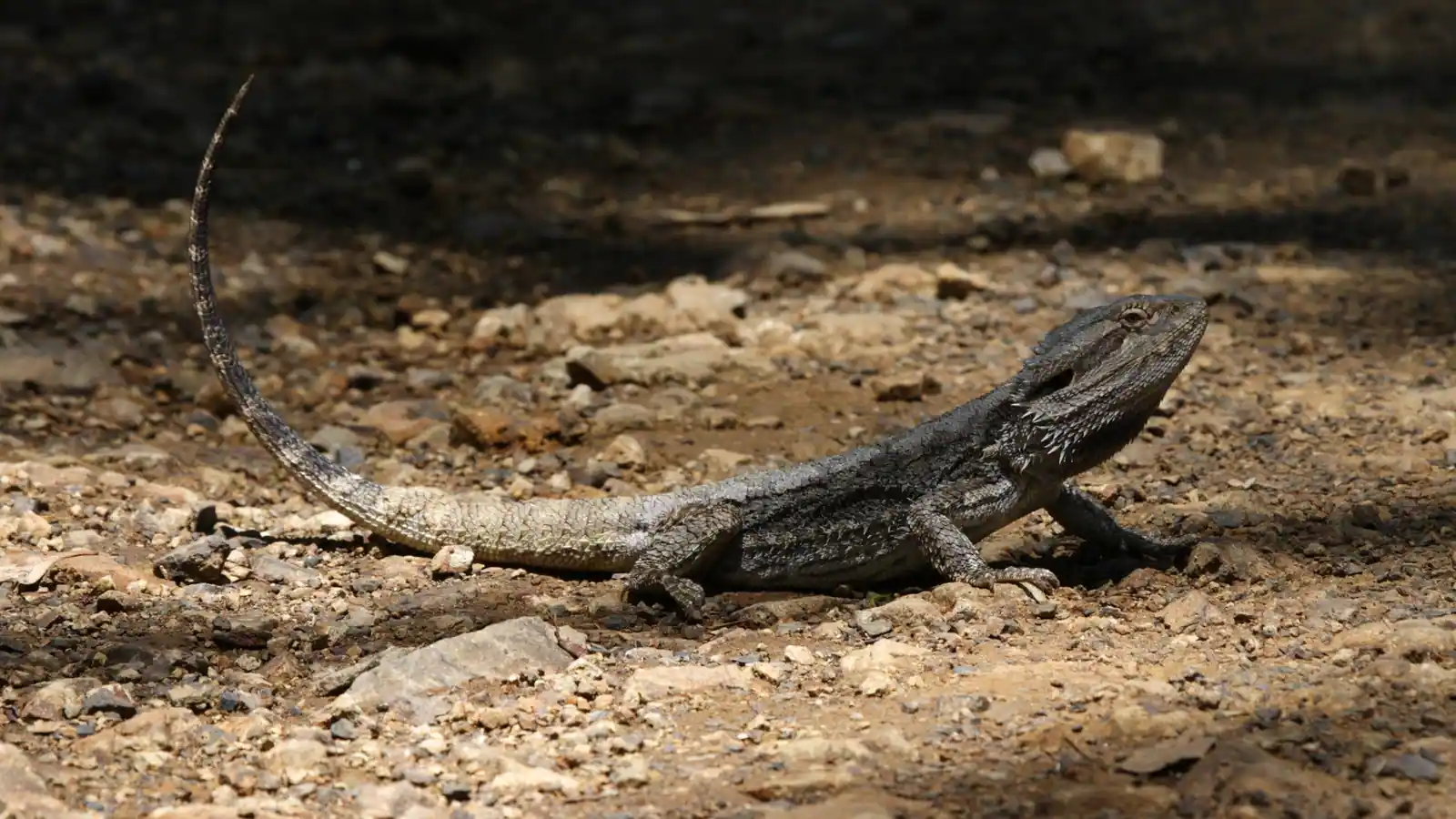
What a zero is
The description: Zero: completely patternless morph in silvery off-white to darker silver/gray shades; recessive mutation
The name comes from having zero pattern. A true zero carries no markings at all: no bands, no blotches, no stripes along the flanks. The effect ranges from a near-white silvery animal to a deeper grey, and it is genuinely unlike a normal dragon in appearance.
For comparison: Dull brown to tan with red or gold highlights; shades of red, brown and yellow that tend to match local soil color; yellow around eyes and sides of head.
And the wild-type build, which zeros share: Broad triangular head, flattened low wide body, stout legs, robust tail; spiny scales along the flanks and an expandable 'beard' throat pouch with spiky scales.
Zero versus witblits
These two get confused constantly, including in sale listings, and the distinction is documented: Witblits: patternless morph in muted earth tones to sandy orange; recessive mutation, distinct from zero
Both are patternless recessive morphs. The difference is tone. Zeros run silvery, white, and grey. Witblits run through muted earth tones to sandy orange.
They are separate mutations rather than versions of the same trait, which matters for breeding. A zero crossed with a witblits does not reliably produce patternless offspring, because the two recessive genes are not the same gene.
| Morph | Appearance |
|---|---|
| Zero | Silvery off-white through darker silver and grey |
| Witblits | Muted earth tones through sandy orange |
| Both | Completely patternless, recessive inheritance |
Source note: morph descriptions from breeder sources, labeled as such, cited below.
The genetics, at the level our sources support
Zero is a recessive mutation, meaning both parents must carry the gene for a zero to appear in a clutch. A carrier that shows normal pattern is described as het zero.
We report that as breeder convention rather than as characterised genetics, because unlike the scale trait it lacks peer-reviewed backing in the sources we cite. The scale trait is the exception with real research behind it: The leatherback/silkback scalation trait shows incomplete dominance; the causal gene is ectodysplasin-A (EDA), identified by Di-Poi & Milinkovitch (Science Advances, 2016) - the same gene whose mutations disrupt hair, teeth, gland and nail development in humans and mice
The honest framing matters here more than in most sections, because morph genetics is an area where confident claims circulate with very little evidence attached.
Why zeros cost more
Recessive morphs are expensive for a structural reason. Both parents must carry the gene, carriers are not visually identifiable without test breeding, and only a fraction of any clutch displays the trait. Add high demand for a striking appearance and prices rise accordingly.
Our setup cost guide covers what dragons and equipment actually cost with real retailer figures, and makes a point worth repeating here: the animal is a small share of what you will spend. A zero costing several times a standard dragon still costs less than the enclosure and lighting that dragon needs for 10 to 15 or more years.
Health and welfare
No documented welfare cost for the zero morph appears in our sources. That is a meaningful contrast with the scaleless silkback, where the cost is measured: Silkbacks lose evaporative water at roughly twice the rate of wild-type bearded dragons, and leatherbacks are intermediate (closer to silkbacks); the morphs do not adjust their thermal preferences to compensate
One consideration is worth raising for pale morphs generally, and we raise it as an open question rather than a warning. Skin colour has a function in this species: Bearded dragons regulate body temperature partly by changing shades of skin colour.
A pale animal has less pigment available for that. How much it matters in a captive dragon with a correct thermal gradient is not addressed by any source we cite, and a proper setup makes the point largely academic: A hot-to-cool temperature gradient is mandatory so the dragon can thermoregulate within its preferred optimal temperature zone (POTZ)
With a basking zone at 95 to 110 F (35 to 43 C) and a cool end at 75 to 80 F (24 to 27 C), a dragon regulates by moving, which is its primary mechanism regardless of colour.
Genetics do appear among documented lifespan factors generally: Factors that shorten lifespan include inbreeding/genetic issues (e.g., silkback morphs with compromised skin), poor husbandry, metabolic bone disease, kidney disease, dental disease, obesity, retained eggs, and lack of veterinary care.
Care requirements
Unchanged from any bearded dragon.
Enclosure: 40 gallons at minimum, with 60 to 100 gallons widely recommended
UVB: Bearded dragons rely on UVB light to synthesize vitamin D3 in the skin; D3 is essential for calcium metabolism, and without adequate UVB they can develop metabolic bone disease (nutritional secondary hyperparathyroidism), weak bones and fractures. Run it Provide a regular day-night light cycle: RSPCA UK and RSPCA SA recommend 12 hours light / 12 hours dark; NCSU: 12-14 hours light in spring/summer and 8 hours in fall/winter; PetMD: 10-12 hours UVB daily; Merck: 12 hours/day suitable for general maintenance. and replace every 6 to 12 months
Humidity: 30 to 40 percent
Diet: the age-based structure in the food section
Hides at both ends: Provide hiding places at BOTH the warm and cool ends of the enclosure; hides can be commercial caves, clay pots or cardboard boxes.
The habitat section covers the complete setup.
One genuine practical advantage of a pale dragon: colour-based signals are easier to read. A darkening beard against pale skin is unmistakable: The beard turns dark to jet black and inflates during displays; used in both threat/aggression and courtship. When threatened, the dragon faces the intruder with mouth wide open and beard puffed out; darkening also occurs with stress, fear or mating arousal.
That helps a new owner learn the vocabulary faster, which the body language guide covers.
Buying a zero
The price makes due diligence more important rather than less.
Verify the morph. Ask if the animal is a zero or a witblits, since listings confuse them. Ask about the parents.
Assess health before appearance. A healthy bearded dragon is alert, active, and aware, with clear bright eyes, a thick round tail base, hips that do not protrude, a clean dry vent, bright pink mouth tissue, and clear saliva.
And reject on: Signs of an unhealthy dragon include a skinny appearance or loose skin, sunken eyes, lethargy or inactivity, a sunken bony tail, wet or soiled vent, cloudy mucus or cottage-cheese-like material in the mouth, and gum redness or pinpoint hemorrhages.
Ask about the clutch. If leatherback genetics are in the line, ask what happened to any silkbacks produced.
Book the first vet visit. A reptile-experienced veterinarian should examine a new bearded dragon within 48 hours of purchase (physical exam, weight, oral cavity, skeletal evaluation, fecal parasite test)
The health check guide covers assessment in detail, and the buying guide covers where to look.
Quick reference
| Feature | Zero |
|---|---|
| Pattern | None; completely patternless |
| Colour | Silvery off-white to darker grey |
| Inheritance | Recessive, per breeder convention |
| Confused with | Witblits, which runs earth-toned |
| Documented welfare cost | None in our sources |
| Care | Identical to any bearded dragon |
The morphs section covers the other traits, including the one that genuinely does change husbandry.