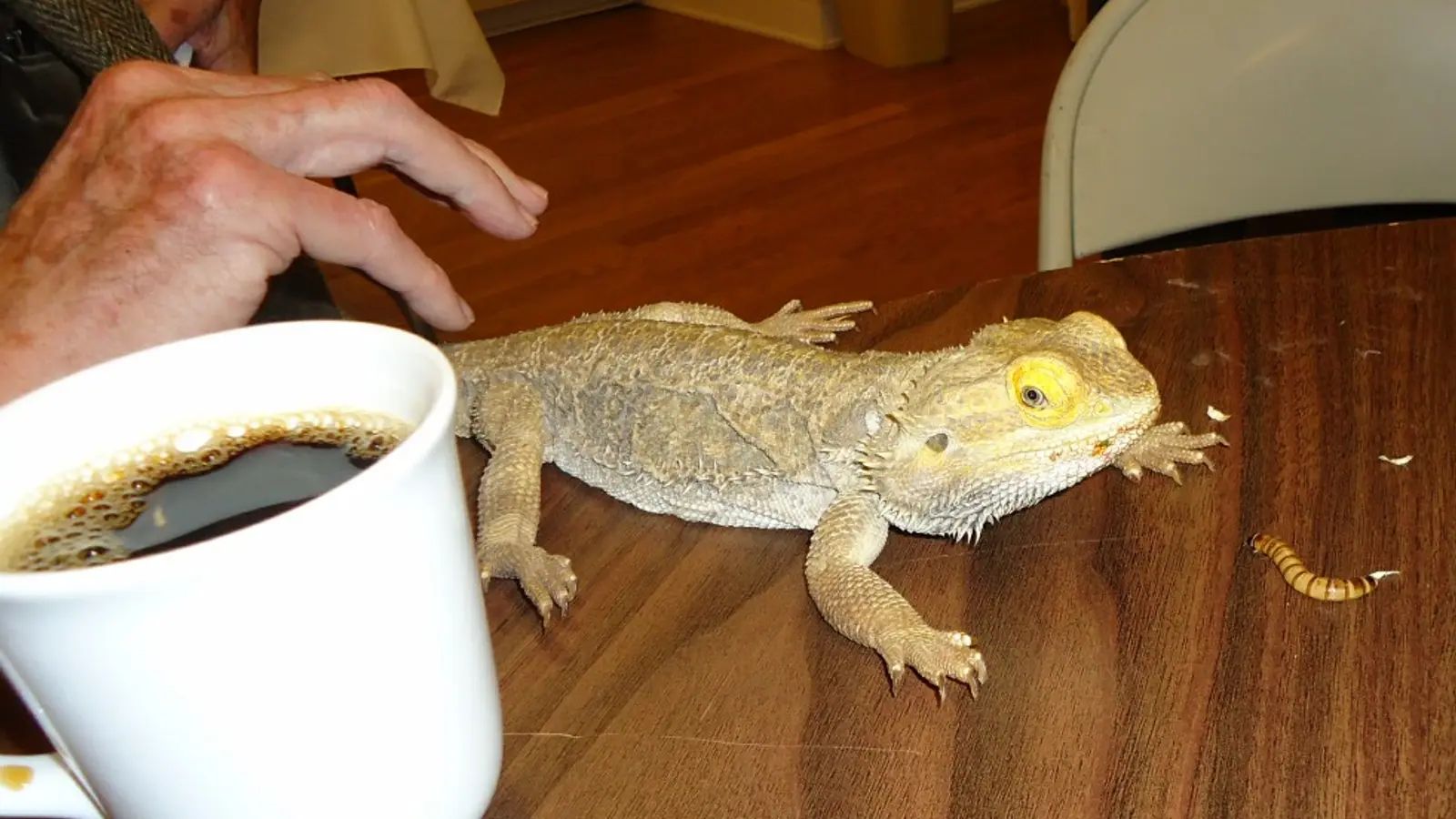
The short answer: they can, but they rarely do
A bearded dragon bite is the exception that proves how tolerant the species is. Described as highly social with keepers, friendly, animated, curious, docile and gentle; docile and interactive when handled often. That temperament is the reason the species dominates the pet reptile trade, and it holds up in practice for dragons kept in correct conditions and handled with basic care.
When a bite does land, it comes from one of two situations: a feeding error, or a dragon whose warnings ran out. Both are preventable, and neither means you own a mean animal.
Food mix-ups: the everyday bite
The most common bite is not defensive at all. A dragon locked onto a wriggling cricket strikes at motion, and a fingertip holding the cricket is motion with food scent on it. Hungry animals strike faster and less carefully.
Three habits remove nearly all of these bites. Offer insects with feeding tongs instead of fingers. Keep fingers flat rather than dangling when hand-feeding greens, since a dangling finger reads like a worm. And wash food scent off your hands before handling, so a curious tongue flick at your skin finds nothing interesting. Tongue flicking itself is harmless investigation, documented as environmental exploration, and it is not a wind-up to a bite.
The warning ladder: what happens before a defensive bite
A defensive bite is the final rung of a ladder the dragon climbs in plain sight. Exotics veterinary sources document the sequence of signals, and each one is a request for distance.
| Signal | What it says | Your move |
|---|---|---|
| Tongue flicking, watching | Assessing, undecided | Proceed slowly |
| Hissing, body puffing | Warning: too close, too fast | Pause, back off |
| Beard darkens and inflates, body flattens | Serious threat display | Withdraw your hand entirely |
| Wide open mouth aimed at you | Final warning | Leave the dragon alone |
Source note: signal sequence from Long Island Bird and Exotics Veterinary Clinic behavior material and RSPCA Australia's description of the threat posture.
The full display is dramatic by design: The beard turns dark to jet black and inflates during displays; used in both threat/aggression and courtship. When threatened, the dragon faces the intruder with mouth wide open and beard puffed out; darkening also occurs with stress, fear or mating arousal. An owner who keeps reaching past that point teaches the dragon that displays fail and only teeth work, which is exactly the lesson you do not want to give. The dragons that bite handlers regularly are usually the ones whose warnings got ignored regularly. Our body language decoder covers every signal on the ladder.
Does a bearded dragon bite hurt?
Here is what the documented record supports. Bearded dragon teeth are real and sharp: Bearded dragons have acrodont dentition: teeth directly ankylosed (fused) to the mandibles and maxilla, are permanent and are not replaced throughout life. An adult is a substantial lizard at 45 to 60 cm (about 18 to 24 inches) and 250 to 510 grams, with jaw muscle to match, so an adult bite can break skin. A hatchling or juvenile has a fraction of that jaw and lands something closer to a pinch.
No veterinary or academic source we cite publishes a pain rating for the bite, so we will not invent one. The practical summary: treat an adult bite as a minor wound to clean promptly, and treat the possibility as a reason to read warnings, not a reason to fear the animal.
Are bearded dragons venomous?
Strangely, yes, and it matters less than it sounds. Bearded dragons are mildly venomous: Fry et al. (Nature 439:584-588, 2006) found Pogona barbata retains an ancestral venom system with serial, lobular non-compound venom-secreting glands on both upper and lower jaws.
The research context helps: Fry BG et al., 'Early evolution of the venom system in lizards and snakes', Nature 439(7076):584-588, 2 Feb 2006 - showed venom systems evolved once in a common ancestor of lizards and snakes and identified venom toxins in Iguania (which includes bearded dragons); nine toxin types are shared between lizards and snakes. The finding rewrote the family tree of venom, showing the machinery is ancient and widespread rather than an invention of dangerous snakes. Animal Diversity Web describes Pogona as mildly venomous, and the fetched sources describe the secretions as mild without documenting any serious effect on humans. The venom is a fascinating fact about your pet's evolutionary history, not a household risk factor, and none of the veterinary care sources we cite treats it as a clinical concern for owners.
What to do after a bite
Treat it like any small animal-inflicted wound plus reptile hygiene. Put the dragon back in its enclosure calmly; dropping a startled lizard causes worse injuries than the bite. Wash the wound with soap and running water, and follow the CDC's reptile rule: CDC: wash hands for at least 20 seconds with soap and water right after touching reptiles or anything in the area where they live, and before preparing food or eating.
The hygiene step is not optional, because carriers look clean: Reptiles, including bearded dragons, can carry Salmonella bacteria while appearing healthy and clean and showing no signs of illness; carriers shed the bacteria in their feces. Households with young children or immunocompromised members should hold the higher line the CDC draws: CDC: children under 5 years old (highest risk of serious illness), older adults, and people with weakened immune systems are at high risk from reptile-associated Salmonella; households expecting or with infants are advised against acquiring pet reptiles. A wound that turns red, swells, or fails to settle gets a human healthcare provider's opinion, the same as any animal bite.
How to prevent the next one
Bite prevention is handling technique plus signal literacy. The technique half is documented: Support the whole body from underneath including fore and hind limbs; do not squeeze; RSPCA UK suggests about 10-15 minutes at a time as a safe handling period; over-handling is stressful. Approach from the side at enclosure level rather than dropping a hand from above like a bird of prey, scoop under the belly, and support the legs.
The signal half is the ladder above, plus patience with new animals. A recently purchased dragon showing constant threat displays is stressed, not defective; give it a settled routine, correct temperatures, and short sessions. The handling and taming guide builds the whole progression, and the petting guide covers reading consent once trust exists.
The bite apparatus, for the curious keeper
The anatomy behind the bite explains both its sharpness and a captive health problem worth knowing about. Acrodont dentition means each tooth is ankylosed to the jawbone itself, with no socket and no replacement row. What wears or breaks is gone, and the arrangement leaves thin gum coverage over the bone. That is why the same anatomy that makes the bite crisp also makes the species prone to dental trouble: The acrodont anatomy makes captive bearded dragons highly susceptible to dental/periodontal disease; advanced cases can progress to bone involvement.
For owners, that cuts two ways. A dragon that bites hard surfaces or cage furniture risks permanent tooth damage, and soft, sugary foods promote the dental disease the anatomy already invites. Hard-bodied gut-loaded insects and crunchy greens are the tooth-friendly menu. If you want the full story of the mouth you are trying not to meet, it is in our guide to bearded dragon teeth.