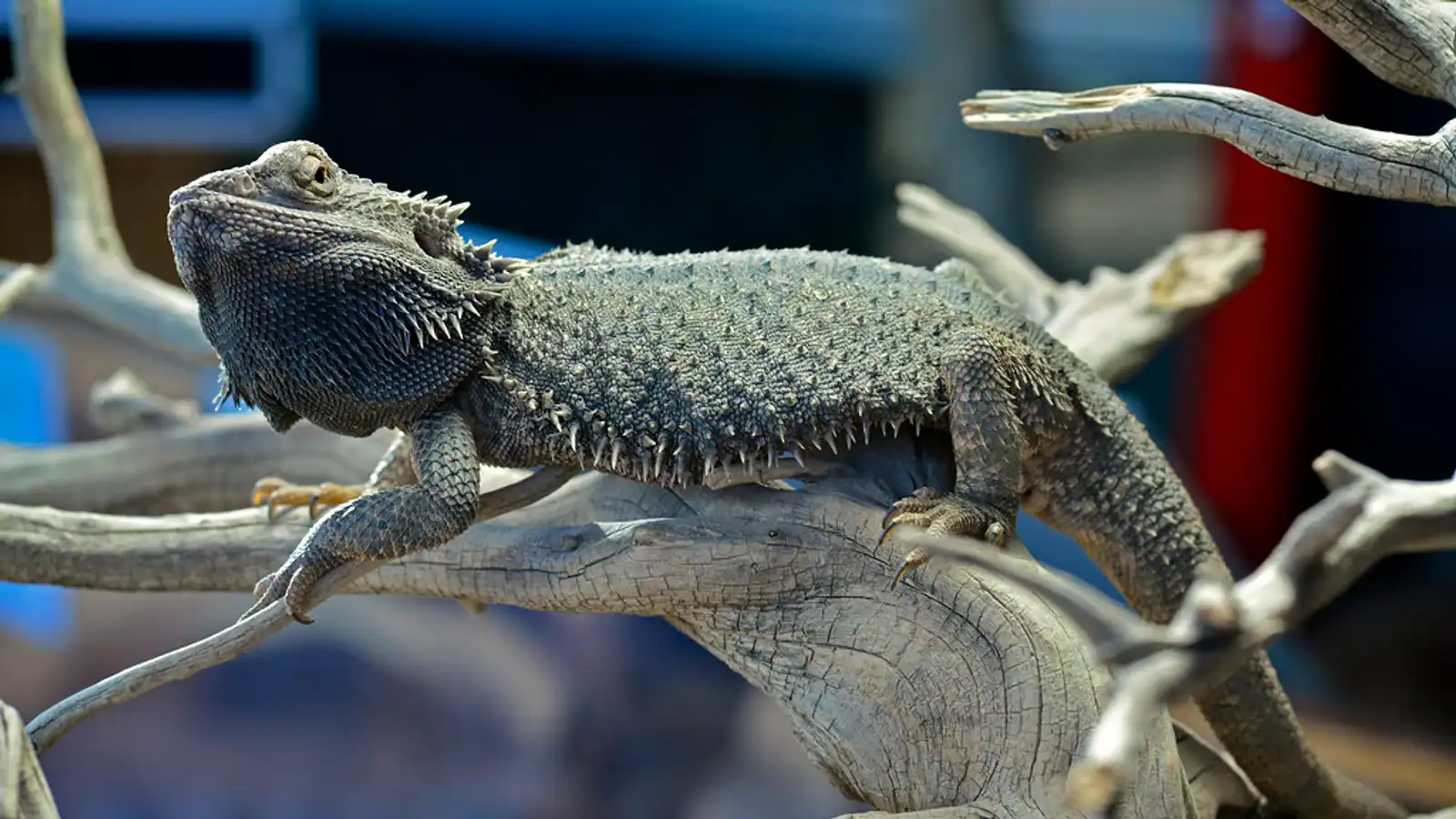
What glass surfing looks like
The dragon stands on its hind legs against a wall, belly pressed to the surface, and paddles its front legs as if trying to swim up the glass. Bouts repeat along the same wall or circle the enclosure, sometimes for long stretches of the day. Occasional brief wall-checking after a change in the room is ordinary curiosity from an alert animal. Repeated daily surfing is the pattern that carries the documented message of stress, boredom, or a blocked urge to leave.
Work through the causes below in order. They run from most common to least, and each has a concrete test.
Cause 1: the enclosure is too small
An adult central bearded dragon reaches 45 to 60 cm (about 18 to 24 inches), and the walls close in fast at that size. The published minimums are larger than most starter kits:
| Standard | Adult minimum |
|---|---|
| RSPCA (UK and South Australia) | at least 120 cm long by 60 cm wide by 60 cm high |
| US veterinary sources (PetMD, VCA) | 40 gallons at minimum, with 60 to 100 gallons widely recommended |
| WSU rule of thumb | Enclosure length at least 3 times the lizard's total body length |
Source note: figures from RSPCA UK, RSPCA South Australia, PetMD, VCA Animal Hospitals, and Washington State University's veterinary teaching hospital; every source stresses larger is better.
A 20 or 40 gallon tank that fit a juvenile becomes a corridor for a 50 cm adult. If your setup misses these numbers, the surfing has an obvious first suspect. The tank size guide breaks down upgrade options.
Cause 2: nothing to do inside
Boredom is one of the three documented drivers, and the fix is structure, not toys. RSPCA South Australia treats furnishing as welfare, not decoration: Provide sturdy basking furniture: large climbable rocks and secured low branches; RSPCA SA calls thick branches, rocks, hollows, basking sites and climbing facilities 'essential to minimise stress and provide choice for self-regulation and environmental enrichment'.
Hides carry equal weight. Provide hiding places at BOTH the warm and cool ends of the enclosure; hides can be commercial caves, clay pots or cardboard boxes. A dragon with no cover option at each temperature zone must choose between feeling exposed and being at the wrong temperature, and that unresolvable choice is chronic stress by design.
A digging outlet rounds out the list. Digging is a natural behavior; captive enclosures should provide substrate that allows it. A plastic tub filled with a sand and soil mixture, entrance cut in the top, sits in the cool end and gives the urge somewhere to go. Layout ideas are in the tank decor guide.
Supervised time outdoors adds one more documented outlet. RSPCA SA recommends dragons receive natural sunlight for 20-30 minute periods at least 2-3 times a week (climate permitting) The safety rules are strict: Outdoor time requires an escape-proof, predator-proof cage or secure pen, constant supervision, and always-available shade; a dragon that cannot escape the heat risks hyperthermia and life-threatening organ shutdown (RSPCA SA); do not put the enclosure behind glass/plastic, which blocks UVB. Done right, those sessions deliver real sunlight and novelty a restless dragon can actually use; the full setup is in our guide to taking bearded dragons outside.
Cause 3: the temperatures are pushing it around
Dragons manage body temperature behaviorally, shuttling between hot and cool zones all day. A hot-to-cool temperature gradient is mandatory so the dragon can thermoregulate within its preferred optimal temperature zone (POTZ) Break the gradient and the animal cannot settle anywhere: a tank that is uniformly hot produces a lizard trying to leave the heat, and a cold tank produces a sluggish one that cannot digest and grows restless in the wrong way.
Measure before assuming; VCA and RSPCA South Australia both specify the method: Use two thermometers, one at the cool end and one at the warm end near the heat source. The targets: basking at 95 to 110 F (35 to 43 C), cool end at 75 to 80 F (24 to 27 C), and humidity around 30 to 40 percent. A dragon that surfs mainly at the hot end wall while gaping is likely over target; one that surfs after days of gloomy, underheated conditions is under it. Full setup numbers are in the temperature guide.
Cause 4: another animal is the stressor
The trigger is sometimes on the other side of the glass. A cat that patrols the tank lid, a dog resting in the sight line, or a bird cage across the room reads as a predator on watch. Move the enclosure or block the sight line and see what changes over a week.
A second dragon is worse than any of those. House bearded dragons individually: RSPCA SA states they 'can inflict severe damage to each other, resulting in loss of limbs and even death' and that keeping multiple females together 'is not a safe practice and is best to avoid'; RSPCA UK: 'it's best to house bearded dragons separately'. The subordinate animal in a shared tank often shows the most wall pacing, because appeasement displays like arm waving fail to buy distance in a box with no exit. Separate enclosures end that contest permanently; our cohabitation guide explains why nothing else does.
What to rule out before you relax
Two checks stop you from filing a real problem under "just stress."
First, appetite, where PetMD draws a hard line: Leaving food after a meal can be one of the first signs of illness in a lizard, and not eating at all - even once - is a sign that cannot be ignored. Restlessness with refused food is a vet visit, not a decor project.
Second, eggs. The RSPCA notes that It is quite common for female bearded dragons to develop eggs even if they have never been with a male; this is not a problem if she is offered a digging box in which to lay her eggs, but without one she may become egg bound, a serious condition. A mature female that suddenly paces, digs, and skips meals deserves a nesting box and, if she becomes lethargic, urgent veterinary care. The digging guide covers the gravid female scenario in detail.
Choice is the design principle
The deeper pattern behind every fix above is choice. Merck's reptile husbandry chapter defines the goal: reptiles need to move within a preferred optimal temperature zone, and for bearded dragons that zone is Preferred optimal temperature zone (body temperature range) for bearded dragons: 25-32 C (77-90 F) as a body temperature range. The enclosure's job is to make every point in that range reachable, with cover available at each stop.
Run the audit as a dragon would. From the basking platform, can it reach a cool retreat without crossing open ground? Is there a hide at both ends, a raised perch, a digging site, and enough floor length that the hot and cool zones are genuinely different places rather than two halves of the same puddle of heat? A tank that passes gives the animal something to do with every hour of the day: bask, retreat, dig, climb, patrol. A tank that fails leaves one behavioral outlet, and that outlet is the glass.
Give the fixes two to four weeks before judging them. Wall pacing that survives a corrected setup, or arrives with any symptom from the sick dragon checklist, goes to a reptile vet with a video of the behavior.