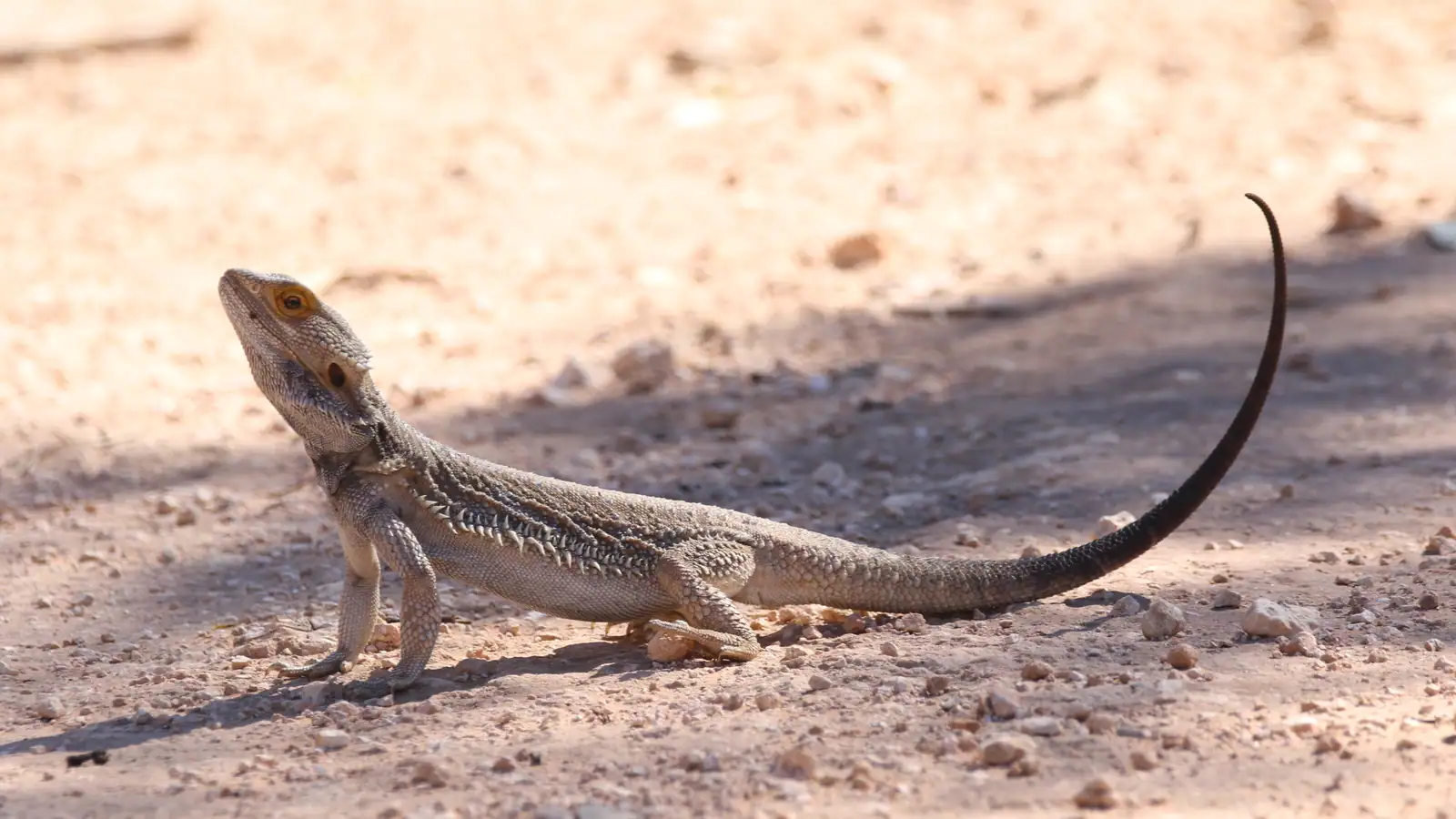
A gape at the basking spot is normal
The most common version of this behavior needs no fix at all. A dragon flattens out under its lamp, warms toward its target body temperature, and opens its mouth part way, holding the pose calmly for minutes at a time. The Australian Museum documents the pairing directly: Bearded dragons bask to raise body temperature and gape (open the mouth) to cool by evaporative cooling when overheated.
The logic is plumbing. A reptile heats up by absorbing radiant heat and has no sweat glands to dump the excess. An open mouth exposes moist tissue to the air, and during extreme heat the mechanism gets specific: During extreme heat, bearded dragons thermoregulate behaviorally, opening their mouths (gaping) to cool blood passing through the head by evaporative cooling. A basking gape means the dragon has hit its preferred temperature and is holding station, fine-tuning instead of leaving the warm spot. It is a sign the basking zone works.
Read the gape by location and company
The same open mouth carries different messages in different corners of the tank.
| Where and how | Likely reading | Action |
|---|---|---|
| Relaxed gape under the basking lamp | Normal thermoregulation | None |
| Gaping at the cool end or hiding from the heat | Enclosure likely too hot overall | Measure both zones, fix the gradient |
| Wide gape with puffed black beard and flattened body | Threat display | Remove the stressor, give space |
| Open-mouth breathing at rest, with mucus, bubbles, or effort | Possible respiratory infection | Reptile vet |
| Mouth that cannot close, swelling, cottage cheese material | Possible mouth rot | Reptile vet |
Source note: readings compiled from the Australian Museum, Long Island Bird and Exotics Veterinary Clinic, VCA Animal Hospitals disease pages, and RSPCA temperature guidance.
When the whole tank is too hot
The gape becomes a warning when it happens away from the heat. A dragon that sits at the cool end with its mouth open is trying to shed heat in the one place that should not require it, which usually means the gradient has collapsed and the entire enclosure sits near basking temperature.
Heat with no escape is dangerous for this species. RSPCA South Australia warns in its outdoor caging advice that a dragon unable to escape heat risks hyperthermia and life-threatening organ shutdown, and the same physics applies to a sealed tank with an oversized bulb. Verify rather than guess: Use two thermometers, one at the cool end and one at the warm end near the heat source. The targets are 95 to 110 F (35 to 43 C) at the basking site, 75 to 80 F (24 to 27 C) at the cool end, and night lows no colder than 65 to 70 F (18 to 21 C). If the cool end reads above its range, add ventilation, lower bulb wattage, or raise the fixture, and recheck. The temperature guide walks through each adjustment.
Lamp position deserves its own check while the thermometers are out, because a too-close bulb overheats a basking dragon before the room air shows anything wrong. Basking lamp must not be positioned too close to the lizard (RSPCA UK: back no closer than 25-30 cm from the lamp); basking area should be as large as the dragon so the whole body heats evenly; guard lamps to prevent burns.
The threat gape
The defensive version looks different from the first second. The mouth opens wide rather than part way, the beard inflates and darkens, and the body flattens to look bigger. The beard turns dark to jet black and inflates during displays; used in both threat/aggression and courtship. When threatened, the dragon faces the intruder with mouth wide open and beard puffed out; darkening also occurs with stress, fear or mating arousal.
Expect it from a dragon that feels cornered: a fast hand from above, a household pet at the glass, or a rival dragon in view. The display is the last warning before a bite, so respect it, withdraw, and let the animal settle. The escalation ladder it belongs to, from tongue flicks through hissing to the full display, is mapped in our black beard guide and the body language decoder.
When an open mouth means illness
Two documented conditions put an open mouth on their symptom lists, and both are vet territory.
Respiratory infection. Signs include sneezing, discharge from the eyes or nose, bubbles from the mouth or nose, rapid or shallow breathing, open-mouth breathing, difficulty breathing, decreased appetite, and lethargy. The giveaways separating this from gaping: it happens at rest and away from heat, breathing looks effortful, and discharge or bubbles appear. The causes are mostly environmental: Respiratory infections (including pneumonia) occur in dragons that are stressed, improperly fed, or kept in poor, cold, or dirty conditions; causes include bacteria, viruses, fungi, and parasites, plus unfavorable temperatures, unsanitary conditions, malnutrition, and vitamin A deficiency. Humidity is a lever you control, and the target is 30 to 40 percent, measured with a hygrometer at the cool end. Our respiratory infection guide lists the full picture.
Mouth rot. An infection of the gums and jaw can leave a dragon physically unable to close its mouth. Signs include pinpoint hemorrhages on the gums, red/inflamed or bleeding gums, gum swelling, excessive thick mucus, cottage-cheese-like material in the mouth, loss of appetite, inability to close the mouth, and jaw swelling in advanced cases. One reassurance while you check: Some bearded dragons naturally have yellow pigmentation inside the mouth - this alone is normal and not a sign of disease; healthy mouth tissue is bright pink with clear saliva. Any sores, swelling, or mucus changes warrant a veterinary exam.
A gaping dragon that also refuses food, sits lethargic, or breathes with visible effort has left behavior territory. Reptiles typically do not show signs of illness until disease has significantly progressed, so subtle changes matter and owners should not wait to see if the lizard recovers on its own.
The thermoregulation engine behind the gape
For keepers who want the full mechanism: everything above is one system, and the gape is its finest adjustment knob. Merck lists the preferred optimal temperature zone for bearded dragons as Preferred optimal temperature zone (body temperature range) for bearded dragons: 25-32 C (77-90 F) as a body temperature, and an ectotherm holds that zone entirely through behavior. The coarse control is position, shuttling between basking site and cool end. The medium control is color: Bearded dragons regulate body temperature partly by changing shades of skin colour. The fine control is the gape, dumping evaporative heat from the head without giving up the basking spot.
Wild dragons add altitude to the toolkit. Bearded dragons are adept climbers in the wild - one Australian Museum observation records a dragon perched in the same tree 3 m above ground for three weeks during extreme heat. Elevation buys airflow and distance from hot ground, which is one argument for a sturdy climbing branch in captivity.
Read in sequence, the tools tell you the tank's story. A dragon that basks, gapes, then moves off to patrol is cycling normally through its zone. A dragon stuck at one extreme, always dark and pressed to the glass at the hot end, or always gaping at the cool end, is running out of behavioral options, and the enclosure needs the adjustment its body is asking for.