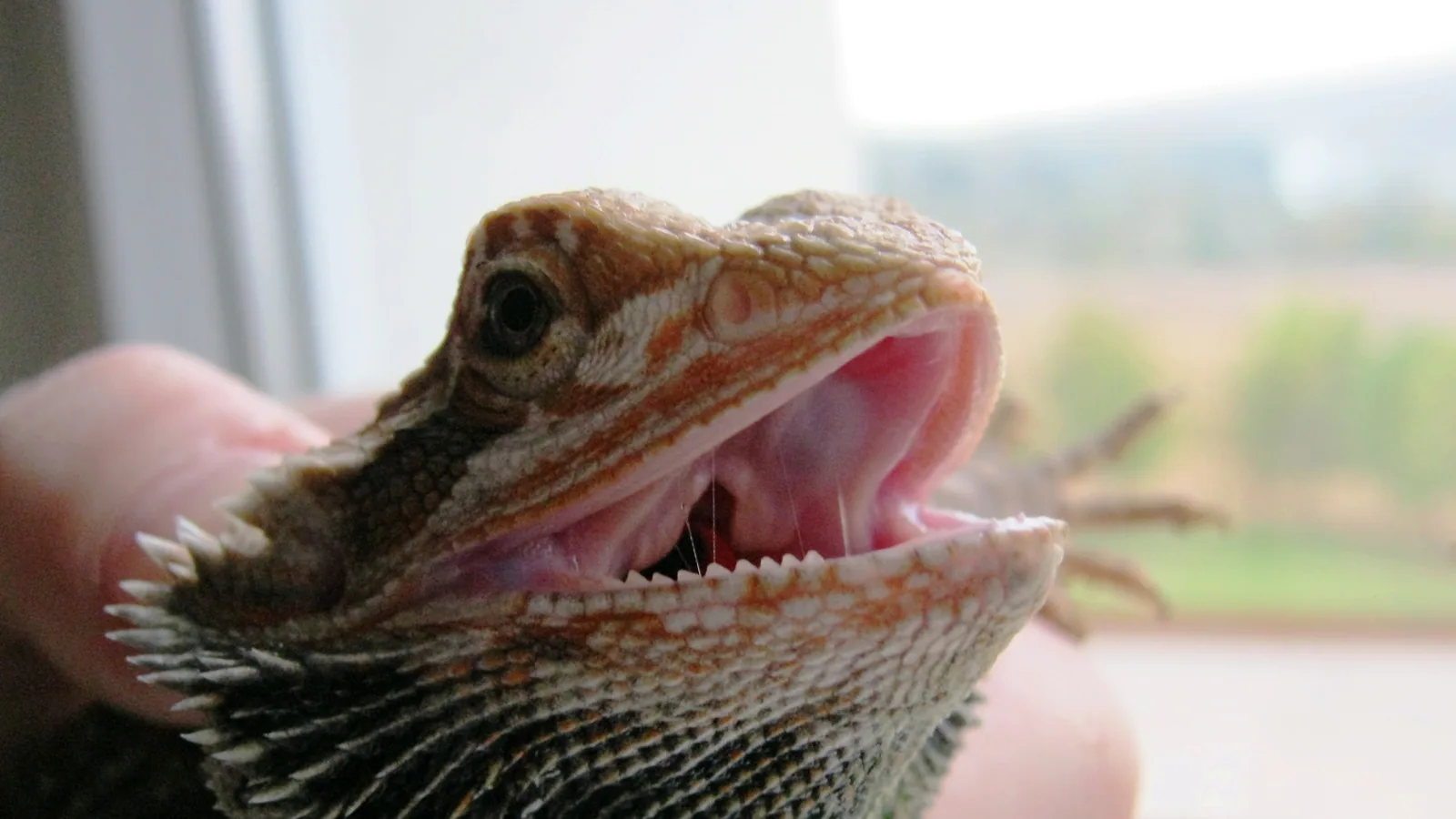
What "liking" contact means for a lizard
Start with the strongest documented statement available. VCA Animal Hospitals describes pet bearded dragons in terms no other reptile earns as often: Described as highly social with keepers, friendly, animated, curious, docile and gentle; docile and interactive when handled often. Dragons that get regular, calm human contact stay noticeably easier to interact with than dragons that get none, and plenty of individuals climb onto an offered hand without prompting.
Now the asterisk. Not social - solitary animals; should be housed individually, and males must be kept separately (territorial) A wild bearded dragon spends its life alone and meets other dragons mostly as rivals or mates. It has no social grooming instinct, no pack bond, no wiring that craves touch the way a dog's does. So the accurate model is tolerance shading into positive association: your hands predict warmth, food, and safe exploration outside the tank, and a well-socialized dragon relaxes into that. To call it affection stretches past what any source we cite documents, and treating your dragon like a small scaly dog leads to over-handling, which the RSPCA flags as genuinely stressful.
Our guide on do bearded dragons recognize their owners digs into the bonding evidence in more detail.
Read the answer off the animal
Every petting session is a running conversation, and dragons answer clearly if you know the vocabulary.
| Green lights: continue | Red lights: stop now |
|---|---|
| Loose, settled posture; eyes soft or closing | Body flattens, beard darkens or inflates |
| Normal coloration, beard stays light | Hissing or body puffing |
| Stays put or leans in; climbs toward you | Backing away, scrambling, tail twitching |
| Slow tongue flicks, casual looking around | Open-mouthed display aimed at your hand |
Source note: stress and threat signals from Long Island Bird and Exotics Veterinary Clinic behavior material and RSPCA Australia's threat posture description; comfort signs are their documented absence.
The red column is the escalation ladder this species runs before a defensive bite: Other defensive/communication behaviors documented by an exotics vet clinic: hissing (warning), body puffing (appear larger), tail twitching (agitation/excitement), tongue flicking (environmental exploration) A dragon showing any of it is done with the session. End contact at the first signal and you teach your dragon that communication works, the foundation every relaxed reptile interaction is built on. Ignore the signal and you teach the opposite lesson, covered in our guide to why bearded dragons bite.
An arm wave during your approach deserves its own mention: it is appeasement, a dragon acknowledging something bigger. Take it as a cue to slow down rather than a greeting.
How to pet a bearded dragon properly
Approach from the side, not from above. A shape dropping from overhead is the silhouette of a predator, and this species is specifically equipped to notice: Lizards have a parietal 'third eye' atop the head with a primitive retina and photoreceptor cells; it detects changes in light and dark and helps regulate hormone production (circadian/thermoregulatory function) A hand descending from directly above throws a shadow across exactly that sensor. Come in low, at the dragon's eye level, and let it see the hand before contact.
Support the body during any lifting. Support the whole body from underneath including fore and hind limbs; do not squeeze; RSPCA UK suggests about 10-15 minutes at a time as a safe handling period; over-handling is stressful. Petting inside the enclosure needs no lift at all; for out-of-tank sessions, scoop under the chest and hindquarters so no part dangles.
Use light, slow strokes in one direction, head toward tail. Scales lie like shingles, and rubbing against their grain lifts and irritates them. One or two fingers on the top of the head, the beard's sides, or along the back suits the animal's size. Skip the belly, which is where predators attack from, and never drag against the spiny flank scales.
Keep sessions short. The RSPCA's 10 to 15 minute guidance exists because over-handling is a documented stressor even for tolerant individuals. Several short sessions spread across a week build more trust than one marathon.
How to build tolerance in a new or nervous dragon
Tolerance is trained, and the training is boring on purpose. For the first week or two in a new home, skip petting entirely and let the dragon learn the routine: lights, food, your movements around the room. Then start with presence, a still hand resting in the enclosure while the dragon does something pleasant like eating. Graduate to brief side-on strokes, then to short lifts, always ending before the red column shows up.
Regularity is the active ingredient, since VCA ties the docile, interactive temperament specifically to dragons handled often. A dragon petted for five calm minutes most days settles faster than one grabbed for an hour on weekends. The full progression, including taming a defensive rescue, is in our handling guide.
Age shifts the baseline too. Juveniles are flightier, and there is a biological reason: Young bearded dragons are semi-arboreal; adults are mostly terrestrial but remain excellent climbers and perch on elevated sites to bask. A young semi-arboreal lizard reads fast overhead movement as death from the sky. Adults, more terrestrial and more habituated, typically sit calmer under the same hand.
The hygiene rule that never bends
One habit is non-negotiable after every session: CDC: wash hands for at least 20 seconds with soap and water right after touching reptiles or anything in the area where they live, and before preparing food or eating.
Apply it after every session, including quick in-tank strokes. The CDC's household rules go further: CDC: keep reptiles out of areas where food or drink is prepared, served, or stored (kitchens, outdoor patios); do not bathe reptiles in kitchen or bathroom sinks - use a tub or bin dedicated to reptile use only; clean reptile equipment outside the house and disinfect any surfaces reptiles contact. Households with children under 5, older adults, or immunocompromised members should let those members admire without touching, per the same CDC guidance, since those groups face the highest risk of serious illness from reptile-associated Salmonella.
What your dragon actually senses when you pet it
Experienced keepers can refine technique further by knowing the sensory equipment involved.
The parietal eye leads. It has a primitive retina and photoreceptors tuned to light change rather than images, which makes it a motion-and-shadow alarm aimed at the sky. This is why side approaches feel so much calmer to the animal than identical contact from above: the alarm channel simply never fires.
Their hearing is better than the missing ear flaps suggest. Lizards have external ears (visible ear openings rather than protruding ears) and appear to hear better than snakes. Speaking quietly before and during contact gives the dragon an extra predictability cue at no cost.
Vision dominates, and it is sharper than ours in one dimension: Diurnal lizards share a highly conserved ancestral pattern of four spectrally distinct cone classes (UV-, short-, medium- and long-wavelength sensitive), suggesting tetrachromatic colour vision extending into ultraviolet. A hand that moves slowly and visibly through that visual world, at eye level, in good light, is a known object arriving on schedule. The whole craft of petting a bearded dragon reduces to that sentence: be a known object, arriving slowly, on schedule, and stop when the animal says stop. The body language decoder covers everything it says in reply.