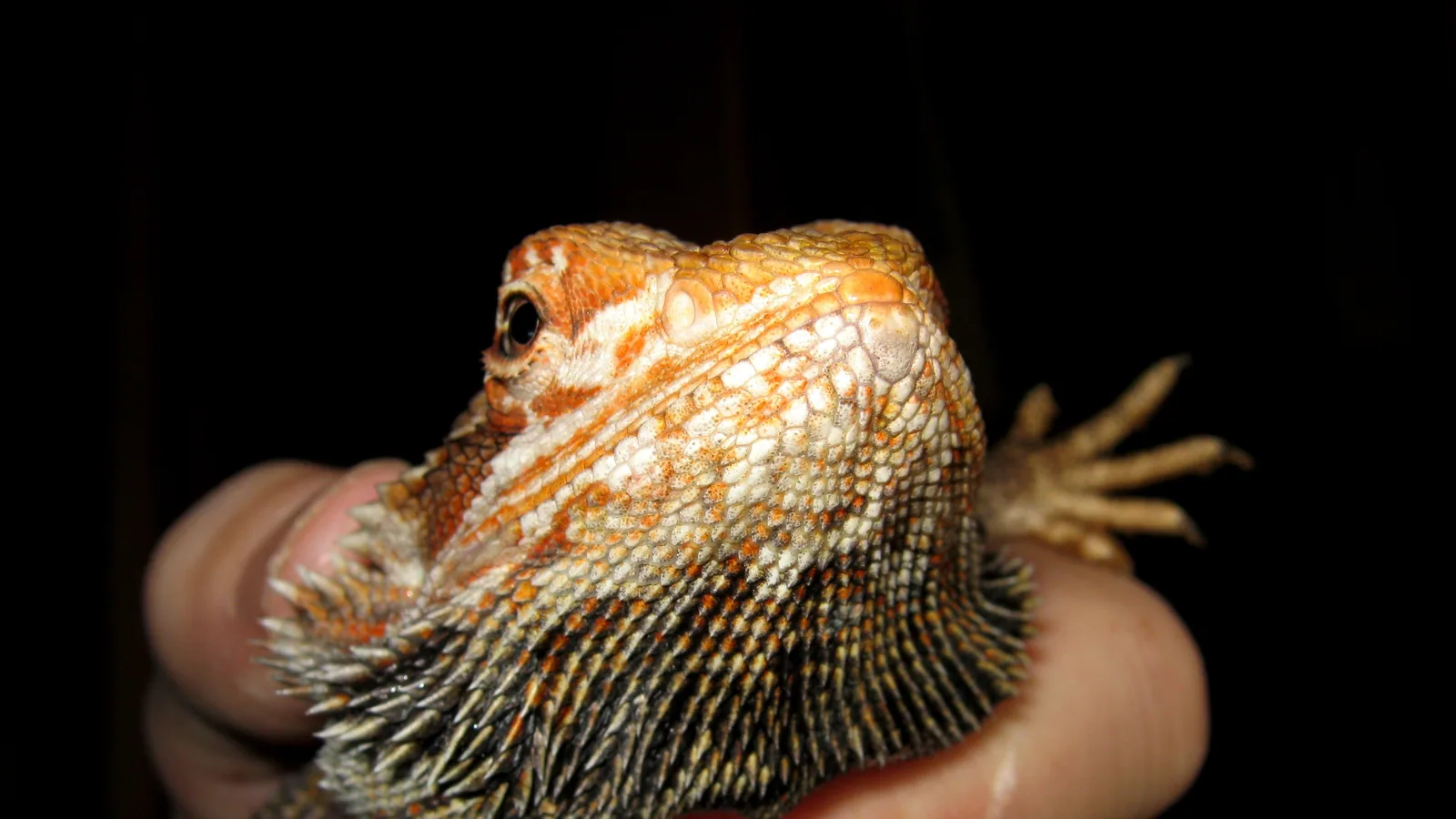
Night sleepers on a strict schedule
Bearded dragons run on daylight. Diurnal - active during the day In the wild that means activity from morning bask to evening wind-down, then sleep through the dark hours, and captive dragons keep the same shape when their lighting allows it.
The operative word is dark. A dragon's sleep period is defined by its photoperiod, and the veterinary consensus clusters tightly: Provide a regular day-night light cycle: RSPCA UK and RSPCA SA recommend 12 hours light / 12 hours dark; NCSU: 12-14 hours light in spring/summer and 8 hours in fall/winter; PetMD: 10-12 hours UVB daily; Merck: 12 hours/day suitable for general maintenance. Under a 12 hour cycle, your dragon gets roughly 12 hours of rest opportunity per night, which is why a dragon that disappears into its hide shortly after lights-out and emerges to bask after lights-on is doing exactly what the species designed.
Run the cycle on a timer rather than memory. Lighting should run on a consistent schedule (timer-controlled day-night cycle) Lights that flick on at random hours produce a lizard that never settles into a rhythm, and rhythm is most of what reptile sleep hygiene is.
The discovery: dragons sleep in stages, like you
For decades, textbooks treated staged sleep, the alternation between deep slow-wave sleep and dreaming REM sleep, as property of mammals and birds. Then researchers at the Max Planck Institute for Brain Research recorded the brains of sleeping bearded dragons and rewrote the chapter. Bearded dragons show both REM and slow-wave sleep (first demonstrated in a reptile; Shein-Idelson et al., Science 352:590, 2016). Sleep cycle is ~80 seconds at 27 C (vs ~30 min in cats, 60-90 min in humans), with the two phases of roughly equal duration.
The compression is the startling part. A full human cycle takes an hour or more; your dragon completes one before you finish reading this section, then starts the next, hundreds of times a night.
| Sleeper | Length of one sleep cycle |
|---|---|
| Bearded dragon | About 80 seconds (measured at 27 C) |
| Cat | About 30 minutes |
| Human | 60 to 90 minutes |
Source note: cycle comparisons from the Max Planck Institute for Brain Research summary of Shein-Idelson et al., Science, 2016.
Why a sleeping lizard rewrote textbooks
The finding reaches far past the terrarium. The bearded dragon sleep findings suggest brain sleep (REM + slow-wave) originated at least 320 million years ago in the common ancestor of amniotes (reptiles, birds, mammals) Every night your dragon sleeps, it is running software older than the dinosaurs, inherited from the same ancestor that handed it to birds, to cats, and to you. Staged sleep stops looking like a mammal invention and starts looking like standard equipment for complex brains.
The species keeps earning its place in laboratories for reasons like this, from sleep research to temperature-dependent sex reversal, and our bearded dragon facts hub collects the rest of its scientific resume.
The right sleep environment, setting by setting
Four settings turn the science into husbandry.
Darkness, absolute. Dragons need the dark half of the cycle actually dark. No colored night bulbs, no room lamps burning into the evening, no television glow against the glass. Light regulation runs deep in this animal; it carries a dedicated light sensor on top of its skull: Lizards have a parietal 'third eye' atop the head with a primitive retina and photoreceptor cells; it detects changes in light and dark and helps regulate hormone production (circadian/thermoregulatory function)
Night heat without light. Cold rooms still need managing, and the documented floor is specific: no colder than 65 to 70 F (18 to 21 C) The equipment answer keeps the darkness intact: ceramic non-light-emitting heaters maintain night temperature, per RSPCA guidance. The full night setup is in our guide to heat at night.
A consistent photoperiod. Twelve on, twelve off is the baseline, with NC State's seasonal variation, 12 to 14 hours of light in spring and summer and 8 hours in fall and winter, as a refinement for keepers simulating natural rhythms. Details live in the UVB lighting guide.
A sleeping refuge. Hides at both the warm and cool ends give the dragon a dark, enclosed sleeping spot at its chosen temperature, and RSPCA South Australia calls hides at both ends imperative for minimising stress.
Brumation: the sleep that lasts weeks
Once a year, sleep can change scale entirely. Brumation is a state of sluggishness, inactivity, or torpor exhibited by reptiles during winter or cold periods; unlike true hibernation, brumating reptiles retain some activity and may seek water to drink.
It is a seasonal program, not a malfunction: In their native Australian habitat, bearded dragons brumate during the southern-hemisphere winter months (May to August), when daytime temperatures are about 68-72 F and nights drop to about 40-44 F. Captive dragons often run a version of it on their own internal calendar. The recognized picture: Brumating dragons become lethargic, refuse food, stop defecating, and their scales may appear darker; slowing down, sleeping more, and eating less in cooler seasons is normal.
Two guardrails keep it safe. First, weight: Dragons should not lose significant weight or stop eating entirely during seasonal slowdown; weight loss during brumation warrants contacting a vet. Second, a pre-brumation vet check: Before allowing or inducing brumation, have the dragon checked by a knowledgeable reptile veterinarian; unhealthy dragons with poor diets or parasites may become critically ill upon waking. The complete management walkthrough is in our brumation guide.
Too much sleep, or sleep at the wrong times
Extra sleep is only reassuring when the season and the setup explain it. VCA draws the line that matters: If the household temperature is a normal 60-70 F (16-21 C), a lethargic dragon may not be brumating - it may be sick; rather than assuming brumation, have the pet examined by a reptile-knowledgeable veterinarian.
Apply it as a quick audit. A dragon sleeping long hours in fall, in an enclosure with correct temperatures and light cycles, while holding weight, fits brumation. A dragon that grows lethargic in a warm room under normal light, loses weight, or shows any companion symptom is telling you something else. Contact a veterinarian if a bearded dragon is lethargic, isn't eating well, or isn't growing normally (WSU); RSPCA advises watching weight and contacting a vet if a dragon loses weight during seasonal slowdown. Reptiles mask illness until late, so err toward the exam; the sick dragon symptom guide lists what to check tonight.
Daytime dozing earns the same scrutiny. An adult that snoozes through its morning bask for days, with lights and heat verified, has left normal territory.
Inside the sleeping brain, for the curious keeper
A few details from the research reward a closer look. The two sleep stages in dragons ran at roughly equal length within each 80 second cycle, a tidier alternation than the mammalian pattern, where REM claims a growing share across the night. The cycle speed was measured at 27 C, a detail worth noticing because it sits inside the species' preferred body temperature zone of Preferred optimal temperature zone (body temperature range) for bearded dragons: 25-32 C (77-90 F). Sleep architecture in an ectotherm is, like everything else, coupled to the thermal environment you build.
And the parietal eye closes the husbandry loop. A light-metering organ wired into hormone regulation means the day-night contrast you provide is not cosmetic; it is the input the dragon's circadian machinery actually reads. Sharp bright days, truly dark nights, on a timer, at the right temperatures: that is the entire recipe, and the 320 million year old sleep program handles the rest.